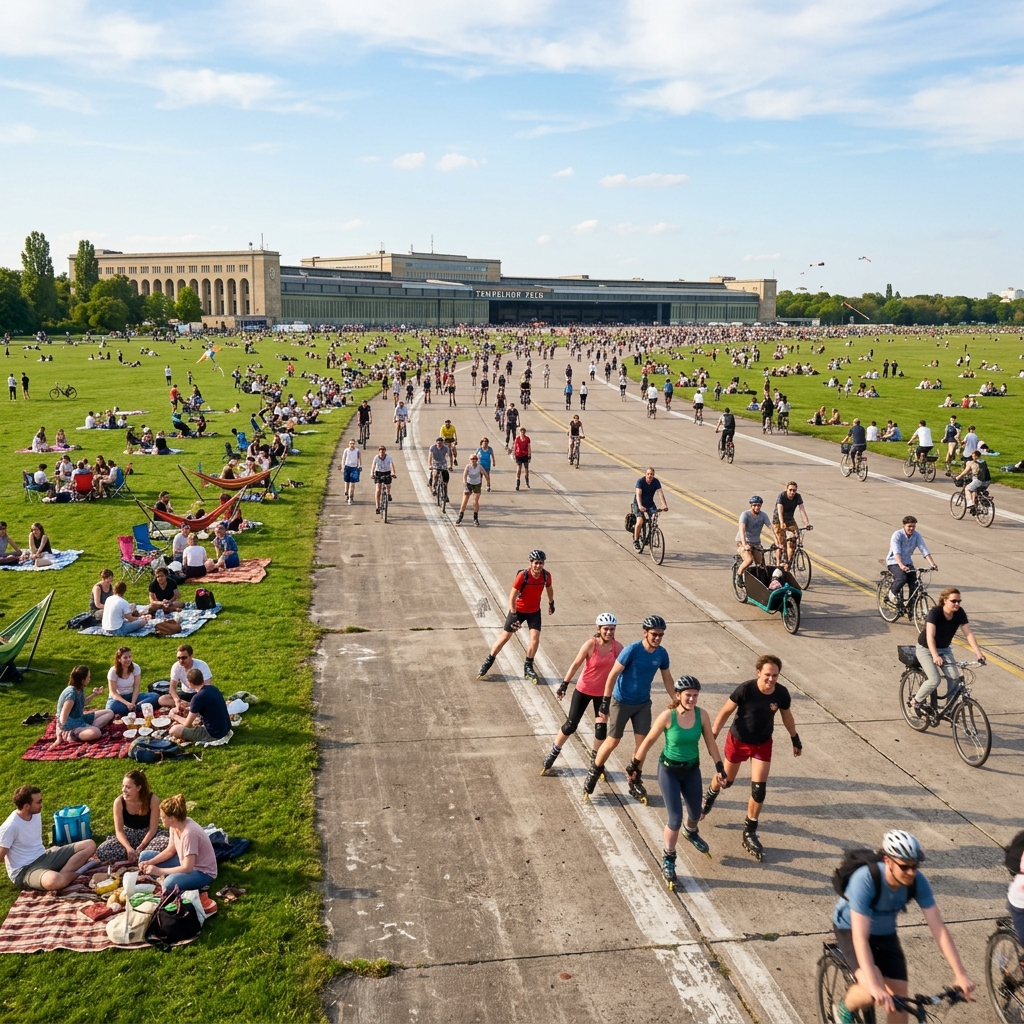
Standing at the center of Tempelhofer Feld on a breezy afternoon is unlike any other urban experience in Europe. Looking in every direction, the horizon opens into an astonishing 355 hectares of uninterrupted sky and prairie grass, framed by the monumental curving arc of the historic airport terminal building. Where Douglas C-54 Skymasters once touched down every ninety seconds during the harrowing 1948–1949 Berlin Airlift, kite-skaters now catch the thermal winds along two-kilometer asphalt runways, families grill Turkish kofta on dedicated barbecue lawns, and endangered skylarks nest in protected central meadows.
Tempelhof is not just Berlin's largest public park; it is a living symbol of grassroots democratic defiance. In 2014, when municipal authorities and luxury developers proposed converting the perimeter of the former airfield into commercial housing and corporate complexes, Berliners organized the "100% Tempelhofer Feld" referendum, voting overwhelmingly to ban all construction and preserve every square meter as an untouchable public commons.
Enter through the Oderstraße entrance on the Neukölln side to explore the Allmende-Kontor community garden—a cooperative labyrinth of recycled wooden planter boxes, sunflowers, and homemade seating. Bring a bicycle or rollerblades; the field is so vast that walking from one end of the runway to the other takes over forty minutes. Note that entrance gates close strictly at sunset; park sirens sound thirty minutes before closing.
From Prussian Parade Grounds to the Berlin Airlift
Long before aircraft took to the skies, Tempelhofer Feld served as the parade grounds and maneuver field for Prussian kings and Kaiser Wilhelm's imperial forces. In 1909, aviation pioneer Orville Wright made historic demonstration flights here before hundreds of thousands of spectators, setting early world altitude records above the sandy plain.
During the 1920s, the Weimar Republic opened Central Airport Tempelhof, which quickly grew into Europe's busiest aviation hub. In the 1930s, the Nazi regime constructed the colossal current terminal complex—designed by Ernst Sagebiel—which remains one of the physically largest contiguous buildings in the world. During the Cold War, the airfield became a beacon of survival: when Soviet forces blockaded land access to West Berlin in June 1948, American and British aircrews conducted the Berlin Airlift (Operation Vittles), flying in over 2.3 million tons of food, medicine, and coal until the Soviets lifted the siege in May 1949.
Pilots like Gail Halvorsen, nicknamed the "Candy Bomber" (Rosinenbomber), famously dropped tiny parachutes loaded with chocolate bars and chewing gum for the children waiting at the perimeter fence, cementing Tempelhof's deep emotional connection to generations of West Berliners.
The Runway Playground: Wind Sports and Urban Living
Following the airport’s commercial decommissioning in 2008 and public opening in May 2010, Berliners transformed the industrial runways into a paradise for human-powered motion and alternative leisure:
- The Main Runways: Two parallel runways, each over two kilometers long, offer smooth, unobstructed pavement perfect for rollerblading, longboarding, land-paddle boarding, and kite-skating (skateboards powered by traction kites).
- Allmende-Kontor Urban Garden: A pioneering community garden on the eastern perimeter where hundreds of local residents cultivate organic vegetables, herbs, and wildflowers in raised wooden crates, bathtubs, and recycled furniture.
- Skylark Conservation Zone: The vast central grassland is roped off during spring and summer to protect ground-nesting Eurasian skylarks (Feldlerche), making Tempelhof one of the most critical urban wildlife refuges in central Europe.
- Designated Grilling Areas: Dedicated zones near the Oderstraße, Tempelhofer Damm, and Columbiadamm entrances equipped with metal ash bins where locals gather for sunset picnics.
- Art and Wind Installations: Scattered across the taxiways are creative open-air timber shelters, mini-skate ramps constructed from reclaimed pallets, and wind-art sculptures that rotate in the brisk crosswinds.
Guided Tours of the Monumental Terminal
While the airfield grounds are free and open to all, the colossal airport terminal building itself is accessible via official guided walking tours operated by Tempelhof Projekt. Spanning over 1.2 kilometers in length, the limestone-clad complex features underground bunkers, wartime graffiti from Soviet soldiers, the historic air traffic control tower, and the cantilevered aircraft hangar roof designed to allow passengers to board planes sheltered from rain.
The terminal stands as a massive example of 1930s National Socialist monumental architecture, providing stark historical context to the carefree open-air recreation unfolding just outside its monumental glass gates. The recently opened rooftop gallery (THF Tower) provides visitors with sweeping 360-degree vistas across the entire field toward the Berlin TV Tower.
Tempelhofer Feld Visitor Essentials
- Entrances: Tempelhofer Damm (U6 Tempelhof / Paradestraße), Columbiadamm (U7 Platz der Luftbrücke), and Oderstraße (U8 Leinestraße / Boddinstraße).
- Park Hours: Opens daily at 6:00 AM; closing times vary seasonally by sunset (6:00 PM in December, up to 10:30 PM in June and July).
- Admission: Completely free access to all field grounds; guided terminal tours require pre-booked tickets.
- Amenities: Public restrooms located at main gates; mobile food and coffee kiosks operate near runways on weekends; no permanent commercial shops inside the park.
- Rules: Dogs must remain on leashes except in three dedicated fenced dog runs; open fires strictly limited to designated barbecue zones; no drones permitted.
Authoritative Local Resources
To check gate opening hours, community project schedules, and terminal history tours, consult these official portals:
- Grün Berlin: Official Guide to Tempelhofer Feld – Park regulations, gate hours, and ecological conservation programs.
- Tempelhof Projekt GmbH – Official terminal tours, architectural exhibits, and historical archives.
- VisitBerlin: Guide to Tempelhofer Feld – Visitor tips, transit connections, and neighborhood highlights from the official tourism agency.
Comments