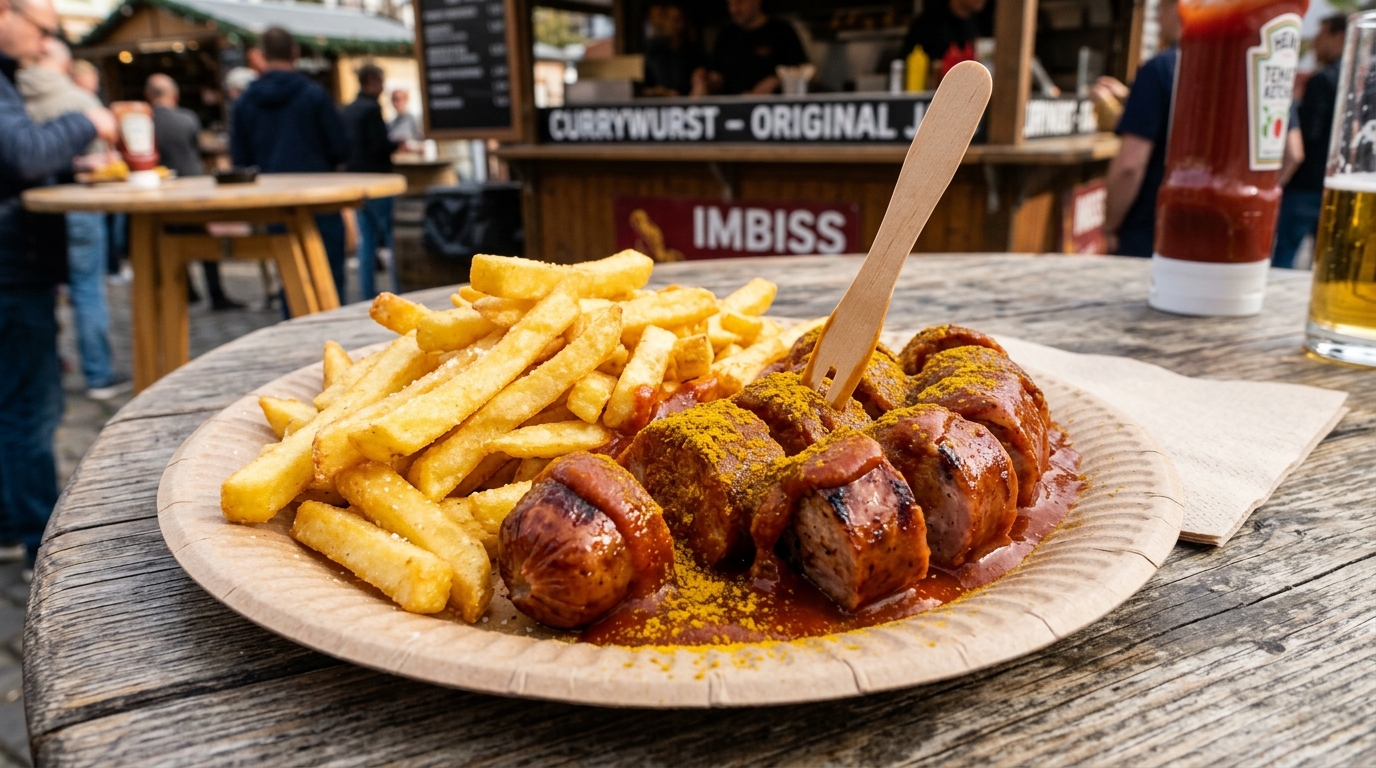
In a capital city that has torn down walls, rebuilt skylines, and reinvented its cultural identity a dozen times over the past century, one culinary constant remains untouchable: the steaming paper tray of currywurst. Served from stainless-steel street kiosks (Imbisse) with a small wooden or plastic two-pronged fork, this post-war street delicacy completely obliterates social hierarchies. At any roadside stand between Charlottenburg and Friedrichshain, you will find construction workers in paint-splattered overalls, suited diplomats, techno ravers fresh off a twenty-four-hour bender, and elderly neighborhood matriarchs leaning elbow-to-elbow against high metal tables, unified by fried sausage and curried ketchup.
Far from a mere fast-food snack, currywurst is a culinary monument to post-war survival, geopolitical division, and the ingenuity of Berliners making magic out of scarce rations amid the rubble of 1949.
Master the counter ordering shorthand like a true Berliner. Order "Einmal Currywurst ohne Darm, Pommes Schranke" for a skinless sausage with fries topped with "barrier style" (red ketchup and white mayonnaise, resembling a railway crossing gate). Purists skip the fries and order their sausage simply with a crisp white bread roll (Schrippe) to mop up every drop of spiced sauce.
The Genesis: Herta Heuwer and the Rainy Night of 1949
The birth of currywurst traces back to a specific, soggy evening: September 4, 1949. In the British occupation sector of Charlottenburg, on the corner of Kantstraße and Kaiser-Friedrich-Straße, an enterprising food vendor named Herta Heuwer was experimenting inside her humble wooden snack shack.
Trading with stationed British soldiers, Heuwer acquired English curry powder and Worcestershire sauce, which she blended with tomato puree, vinegar, and a closely guarded mixture of twelve proprietary spices. She poured the warm, piquant sauce over a sliced, boiled-and-fried pork sausage, instantly creating a sensational comfort food for a city struggling through post-war reconstruction. In 1959, Heuwer officially patented her sauce recipe under the trademarked name "Chillup" (filing patent no. 721319 at the German Patent Office). A commemorative bronze plaque today marks the Charlottenburg street corner where her kiosk once stood.
The Great East-West Divide: Mit Darm vs. Ohne Darm
To truly understand the culture of the Berlin currywurst, you must navigate the defining question asked at every counter: "Mit oder ohne Darm?" (With or without skin?). This culinary distinction directly mirrors the geopolitical partition of the Cold War.
In former West Berlin, the tradition favored Currywurst mit Darm—a cured, smoked pork sausage encased in traditional natural intestine casing, resulting in a crisp, audible "snap" when bitten into. In Soviet-controlled East Berlin, severe post-war shortages of natural sausage casings forced communist state butchers to innovate. They developed a skinless, fine-ground white sausage formed in molds—Currywurst ohne Darm—resembling a tender white bockwurst that is deep-fried to create a delicate outer crust.
Even today, decades after reunification, culinary allegiances remain fiercely localized: eastern districts tend to swear by skinless sausages, while western traditionalists demand the snap of natural casing.
The Sacred Shrines: Where to Eat the Real Thing
While almost every U-Bahn station has a currywurst vendor, serious eaters make pilgrimages to Berlin’s heritage imbiss stands:
- Konnopke’s Imbiß (Prenzlauer Berg): Tucked directly beneath the elevated green iron viaduct of the U2 subway line at Eberswalder Straße, Konnopke’s has operated since 1930. In 1960, Max Konnopke introduced currywurst to East Berlin, cementing the stand’s legendary status. Their proprietary ketchup sauce and skinless sausages remain the benchmark of eastern Berlin.
- Curry 36 (Kreuzberg): Located at Mehringdamm 36 near the U-Bahn station, Curry 36 is a legendary 24-hour institution. Operating with lightning-fast efficiency, the staff serves hundreds of customers an hour, including taxi drivers, nocturnal revelers, and visiting rock bands. They also offer excellent organic (Bio) and vegan currywurst alternatives.
- Bier's Kudamm 195 (Charlottenburg): Situated on the upscale Kurfürstendamm boulevard, this late-night counter stands out for its high-low pairing: it famously serves authentic currywurst on porcelain plates paired with flutes of chilled Moët & Chandon champagne until 5:00 AM.
- Curry Baude (Gesundbrunnen): Located right outside the Gesundbrunnen station, master butcher Reina Lehmann crafts his sausages and sauces from scratch in-house, offering one of the most flavorful, traditional West Berlin recipes in the city.
The Anatomy of the Perfect Plate
A true Berlin currywurst is never an afterthought. The pork sausage is precision-sliced into bite-sized medallions using a mechanical hand-cranked cutter, immediately blanketed in warm, thick tomato-curry sauce, and generously dusted with aromatic yellow curry powder. The sauce must strike a harmonious balance between sweet tomato richness, vinegary tang, and an assertive peppery heat.
Unlike Munich’s ritualized Weißwurst or Frankfurt’s delicate frankfurters, the Berlin currywurst is messy, bold, and fiercely democratic—a culinary staple born of resilience that remains the ultimate soul food of the German capital.
Berlin Currywurst Visitor Essentials
- Konnopke's Imbiß: Schönhauser Allee 44b, 10435 Berlin (U2 Eberswalder Straße). Open Monday–Friday 10:00 AM – 7:00 PM; closed Sundays.
- Curry 36: Mehringdamm 36, 10961 Berlin (U6/U7 Mehringdamm). Open daily 9:00 AM to 5:00 AM (virtually 24/7).
- Average Cost: Approx. €3.50–€5.00 for a single currywurst; approx. €6.50–€8.00 with fries and drink.
- Payment: Primarily cash; small coins and euro bills preferred at traditional street windows.
- Dietary Options: Vegan currywurst (soy and pea-protein based) is now widely available at Konnopke's and Curry 36 with identical spice sauces.
Authoritative Culinary Resources
To explore historical menus, opening hours, and neighborhood guides for Berlin’s culinary heritage, consult these official portals:
- Konnopke's Imbiß Official Portal – Archival history, traditional family recipes, and current opening schedules in Prenzlauer Berg.
- Curry 36 Official Portal – Menu details, locations on Mehringdamm and Zoologischer Garten, and catering archives.
- VisitBerlin: Official Guide to Berlin Currywurst – Comprehensive street food overview and neighborhood vendor recommendations.
Comments