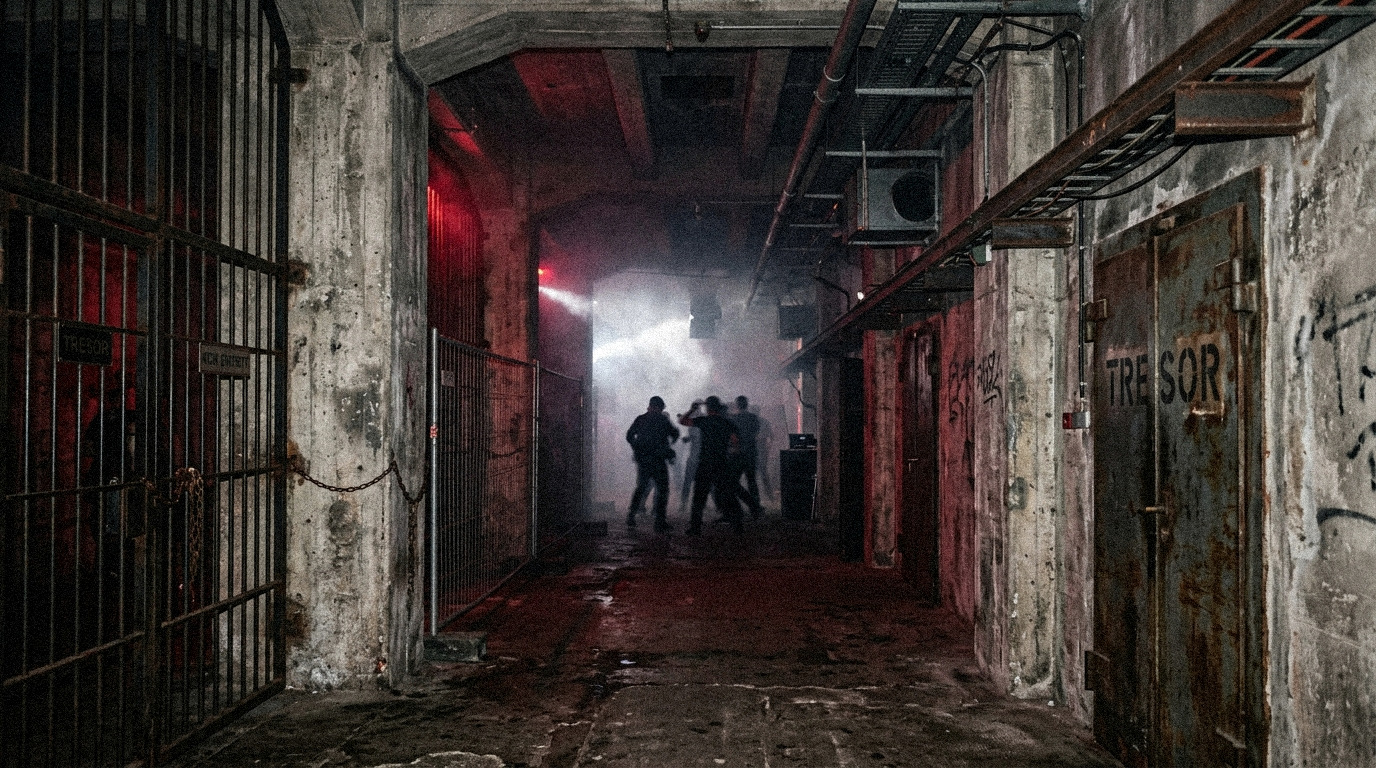
Step off Köpenicker Straße at three o’clock on a freezing autumn morning, and the hulking concrete mass of the former Heizkraftwerk Berlin-Mitte looks less like an entertainment venue and more like a decommissioned Soviet blast furnace. Towering smokestacks cut silently into the damp Berlin night sky, while a subterranean, bone-rattling low-frequency bass tremor travels directly through the asphalt and into the soles of your boots. There are no flashing neon signs, no VIP velvet ropes, and no bottle-service sparklers.
This is Tresor—the institutional anchor of Berlin’s underground techno scene. For over three decades, this former bank vault and thermal power plant has stood as the crucible where sound engineers, counter-culture pioneers, and transatlantic musical revolutionaries turned post-Cold War industrial ruins into the center of European techno. But understanding Tresor requires stripping away the breathless influencer myths and looking at the raw architectural, political, and acoustic history that built it.
The Transatlantic Bridge: Fall of the Wall and the Birth of a Subculture
The story of modern Berlin nightlife began in the chaotic political vacuum of November 1989. When the Berlin Wall collapsed, it didn’t just dismantle a border; it left behind an unregulated, no-man’s-land strip of abandoned industrial warehouses, forgotten basements, and derelict state properties slicing straight through the heart of the city between East and West.
With East German municipal authorities effectively dissolved and West German bureaucracies scrambling to establish jurisdiction, young Berliners seized the moment. In early 1991, cultural instigator Dimitri Hegemann, along with collaborators Achim Kohlberger and Johnnie Stieler, explored the subterranean ruins beneath the Wertheim department store on Leipziger Straße. Flattened by Allied bombing in the Second World War and sealed behind the Wall’s death strip for four decades, the basement hid an intact subterranean labyrinth containing hundreds of heavy steel safe-deposit lockers. They called the space Tresor—the German word for "vault."
Simultaneously across the Atlantic, an economic decline in Detroit was giving birth to a radical, futuristic new sound. Visionaries like Underground Resistance (Mad Mike Banks, Jeff Mills, Robert Hood) and Juan Atkins were crafting relentless, machine-driven electronic soul on vintage synthesizers and Roland drum machines. Hegemann recognized an immediate spiritual kinship between post-industrial Detroit and traumatized, divided Berlin.
Tresor established a direct cultural pipeline with Detroit, flying pioneering Black American DJs into Berlin to play marathons in a pitch-black, strobe-lit concrete bunker. For youth from East Berlin who had grown up under the surveillance of the Stasi, and West Berliners raised in an isolated capitalist island, the relentless 135-BPM rhythms offered an unprecedented language of unification. On the concrete floor of the vault, surrounded by rusted safety deposit boxes, words were irrelevant.
Resurrection in the Machine: The Move to Kraftwerk
In 2005, the original Leipziger Straße vault was demolished to make way for corporate office developments. Pundits proclaimed the death of authentic Berlin clubbing. Yet Dimitri Hegemann refused to capitulate to gentrification.
In May 2007, after two years of searching and painstaking reconstruction, Tresor reemerged inside Heizkraftwerk Berlin-Mitte—a monumental cogeneration power plant built between 1961 and 1964 by the East German government to supply electricity and steam heating to the Soviet sector's administrative district.
Hegemann’s team didn’t merely rent a room; they transported the actual physical relics of the original club. Workers salvaged the original bank vault doors, rows of rusted steel lockboxes, and iron bars from Leipziger Straße and welded them into the basement of the power plant.
Today, entering Tresor feels like descending into a dystopian subterranean fortress:
- The Vault (Tresor): Located down a 30-meter damp concrete tunnel, the lower dancefloor is a sensory crucible. DJs perform inside a literal steel jail cell behind thick iron bars. Industrial fog machines pump atmospheric smoke until visibility drops to arm's length, while minimal strobe lights slice through the haze in sync with punishing, metallic industrial techno.
- Globus: Situated on the upper floor, Globus offers a warmer, acoustically nuanced counterpoint. Featuring polished wooden floors and ambient warm-spectrum lighting, it hosts deeper, melodic house, Detroit electro, and hypnotic groove sets.
- OHM: Housed within the former electrical battery storage room of the power plant complex, OHM functions as an intimate, white-tiled venue dedicated to cutting-edge avant-garde electronica, experimental bass, and community-driven arts programming.
- Kraftwerk Berlin: The main hall of the power plant—a cathedral of raw reinforced concrete with 30-meter-high ceilings—operates as a globally renowned exhibition space and host to progressive festivals like Berlin Atonal.
Berlin's club door policy is not a dress-up contest or a VIP roll call; it is a curation of vibe and safety. To make entry seamless: travel solo or in pairs (large groups are almost always rejected); know the artists on the night's lineup before stepping up to the door; and leave flashiness, loud drunken banter, and bachelor-party attire at home. Dress comfortably in dark, understated clothing suitable for dancing for hours. Once inside, respect the strict no-photography policy—camera lenses are taped at the entrance for a reason: the dancefloor is an anonymous sanctuary where people are free from social media voyeurism. Always carry physical cash, as cloakrooms, deposit tokens (Pfandmarken), and food stalls rarely take foreign bank cards.
Beyond Tresor: The Living Ecosystem of Berlin Nightlife
While Tresor remains the historical backbone, Berlin’s club scene is an expansive, decentralized constellation of autonomous spaces, each maintaining its own distinct subcultural ethos:
- Berghain / Panorama Bar: Housed in a gargantuan former Vattenfall heating plant on the Friedrichshain/Kreuzberg border, Berghain represents the peak of acoustic perfection and queer-liberation club culture. Its marathon Klubnacht sessions run uninterrupted from Saturday midnight through Monday morning, driven by a peerless Funktion-One sound rig.
- Sisyphos: Located eastward along the Spree in Rummelsburg within a decommissioned dog-biscuit factory, Sisyphos delivers an open-air festival experience. Spanning a faux sand beach, abandoned transport vans, wooden treehouses, and multiple indoor rave huts, parties here frequently run without stopping from Friday evening straight to Monday afternoon.
- ://about blank: Situated beside Ostkreuz station, this collective-run, politically engaged club is rooted in anti-fascist and DIY activism. Its wild, overgrown garden and raw multi-room indoor bunker host everything from queer feminist techno collectives to political panel discussions.
- Renate (Salon zur Wilden Renate): A labyrinthine, converted multi-story apartment tenement in Friedrichshain featuring secret staircases, attic dance floors, and an unhinged carnival aesthetic.
Crucially, Berlin does not treat this nightlife ecosystem as mere commercial party commerce. In 2021, the German Bundestag passed landmark legislation officially reclassifying nightclubs as cultural institutions (Kultureinrichtungen), putting them on the same legal footing as opera houses, symphony orchestras, and theaters. In March 2024, UNESCO formally inscribed Berlin techno culture onto Germany’s nationwide registry of Intangible Cultural Heritage—an international acknowledgment that this subculture is a profound, living artistic legacy.
Visitor Logistics and Planning Your Night at Tresor
Practical guidance for visiting Tresor and navigating the Köpenicker Straße complex:
- Location & Address: Köpenicker Straße 70, 10179 Berlin (Mitte/Kreuzberg border).
- Getting There: Take the U-Bahn U8 to Heinrich-Heine-Straße (5-minute walk) or the S-Bahn lines S3, S5, S7, S9 to Jannowitzbrücke (7-minute walk). You can also arrive via U-Bahn U2 at Märkisches Museum.
- Club Nights & Timing: Tresor is active primarily on Friday and Saturday nights (starting at 23:59 and continuing well into the afternoon), as well as its legendary, long-running Wednesday showcase, New Faces, which offers an accessible, intimate entry point for up-and-coming talent.
- Admission & Payment: Door entry generally ranges between €15 and €22 depending on the lineup. Bring sufficient cash (€50–€70) for door admission, drink tokens, and coat check. Drink prices are remarkably reasonable by European capital standards.
- Accessibility: The industrial power plant features steep iron stairwells and cobblestone corridors; however, accessible entrance options are available by coordinating with staff at the door in advance.
Comments