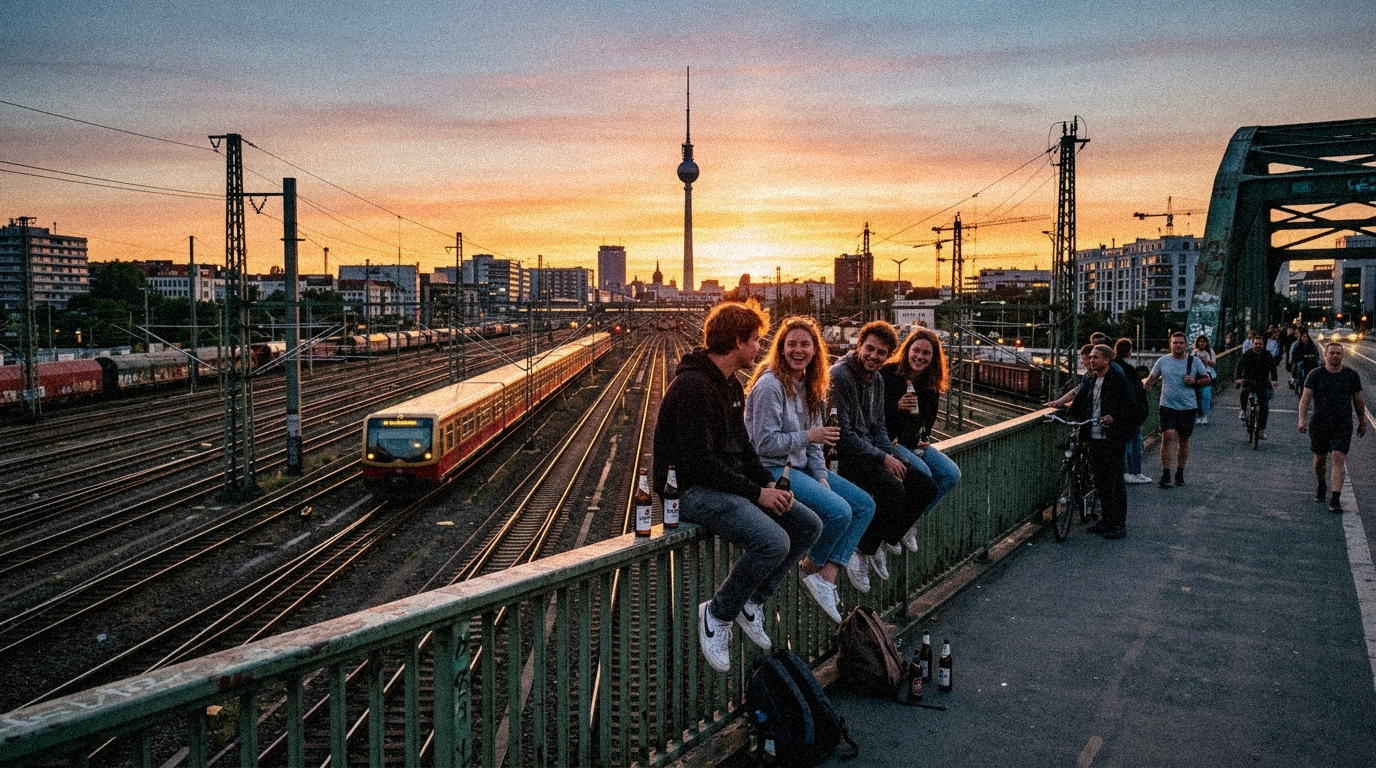
There is a singular alchemy to a Berlin twilight. Because the North German Plain is remarkably flat, the sky over the capital functions like an enormous, unobstructed cinema screen. When a summer cold front clears or an autumn dusk settles across the Spree, the horizon ignites into bruised purples, molten amber, and electric violet. Gritty industrial railyards, brutalist concrete housing slabs, and copper cathedral domes are suddenly bathed in an ethereal, golden glow.
Watching the sunset here is rarely a hushed, formal affair confined to hotel rooftop cocktail lounges. In true Berlin fashion, it is a communal, democratic ritual. Locals grab five-euro cold bottles of Augustiner or Club-Mate from the corner Späti, wander to elevated bridges, abandoned airstrips, or rooftop community gardens, and dangle their legs over the edge to toast the passing day. If you want to experience the city's finest golden-hour vistas, here are seven unbeatable viewpoints across the capital.
1. Modersohnbrücke: The Classic Railway Horizon
Modersohnbrücke in Friedrichshain is widely revered as the definitive Berlin sunset bridge. Spanning the sprawling railway corridor between Ostkreuz and Warschauer Straße, this historic iron and steel road bridge offers an uninterrupted vista directly west toward the center of Berlin.
As the sun dips toward the horizon, its blazing rays reflect off the web of steel rails below, catching the red taillights of S-Bahn trains and regional expresses hurtling into the dusk. Anchoring the skyline straight ahead is the iconic needle of the Berlin TV Tower (Fernsehturm). On warm evenings, hundreds of students, artists, and neighborhood regulars sit perched along the bridge railings, creating an atmosphere that feels like an open-air living room above the tracks.
2. Tempelhofer Feld: 360-Degree Big-Sky Drama
For sheer scale, nowhere in urban Europe competes with Tempelhofer Feld. Spanning over 300 hectares, this decommissioned Cold War airport provides something vanishingly rare in dense cities: a true 360-degree, uninterrupted horizon unbroken by skyscrapers or power lines.
Position yourself toward the center of the dual two-kilometer concrete runways. As sunset approaches, kite-skaters, rollerbladers, and cyclists cast elongated shadows across the tarmac. The monumental curvature of the 1930s Nazi-era airport terminal turns honey-gold against the eastern sky, while to the west, the setting sun sinks across Neukölln and Kreuzberg. The vast expanse makes you feel as if you are standing in an open prairie right in the geographic heart of a metropolis.
If heading to Klunkerkranich for sunset, arrive at least 60–90 minutes before dusk. The queue for the library elevator inside the Neukölln Arcaden shopping center backs up significantly on clear summer evenings. Once on the roof, grab a local craft beer from the wooden bar and grab a spot on the western terrace before the DJ starts.
3. Klunkerkranich: Neukölln's Bohemian Rooftop Oasis
Perched high atop the multi-story parking garage of the otherwise unremarkable Neukölln Arcaden shopping mall on Karl-Marx-Straße, Klunkerkranich is legendary for good reason. What began as a guerrilla cultural garden project has evolved into one of Berlin's most celebrated open-air rooftop venues.
To reach it, you ride the mall elevator up to the 5th floor parking deck, then walk up the concrete vehicle ramp to the top level. The transition is startling: you emerge into a lush maze of salvaged wooden decking, sandbox seating, potted greenery, and acoustic live stages. From the western wooden railing, you look out across the red-tiled sea of Neukölln tenements and church spires, sipping a craft beer while resident DJs soundtrack the darkening sky.
4. Flakturm Humboldthain: Cold War Ruins and Northern Panoramas
In Wedding's Volkspark Humboldthain stands a towering relic of World War II: the partially demolished ruin of Flakturm III, a gargantuan reinforced concrete anti-aircraft bunker. After the war, French occupation forces blew up the southern side, leaving the northern structure buried under millions of cubic meters of city rubble that was later reforested into a public park.
Today, a steep staircase winding up through dense deciduous woods leads you to the bunker's concrete roof platform. At the summit, you stand atop sheer vertical concrete cliffs equipped with modern rock-climbing bolts. Looking south and west, you enjoy an unobstructed panoramic vista across northern Berlin, Wedding's brick industrial smokestacks, and the central skyline, with virtually zero commercial crowds.
5. Drachenberg: Grunerwald's Spy-Hill Viewpoint
While most tourists flock to the geodesic radar domes of Teufelsberg, knowledgeable locals often head to its slightly shorter neighbor: Drachenberg (Kite Mountain). Rising 99 meters above sea level in the Grunewald forest, this treeless plateau of compacted wartime debris offers a stark, sweeping summit completely open to the wind.
Because there are no tall trees or radar dome entrance fees to block your sightlines, Drachenberg offers an astonishing 360-degree panorama. You can look west toward the sunset gleaming over the Havel river, or gaze east to see the entire Berlin skyline—from the Olympiastadion to Alexanderplatz—etched sharply against the dusk.
6. Viktoriapark & Kreuzberg National Monument
Situated atop the Kreuzberg hill—the highest natural elevation in inner-city Berlin at 66 meters—Viktoriapark is centered around a dramatic artificial waterfall that cascades down rugged boulders toward Großbeerenstraße. At the crest sits Karl Friedrich Schinkel's neo-Gothic cast-iron national monument commemorating the Prussian Liberation Wars.
The paved terrace beneath the monument provides a commanding northward view down the tree-lined axis of Kreuzberg and Mitte. As the sun sets to the west, soft golden light filters through the canopy, illuminating the spray of the waterfall and the bustling streets below.
7. Admiralbrücke: The Kreuzberg Living Room
If you prefer your sunset at water level surrounded by neighborhood chatter, Admiralbrücke in the Graefekiez neighborhood is unmatched. Spanning the Landwehrkanal, this wrought-iron cobblestone bridge becomes a pedestrian sanctuary as twilight approaches.
Locals sit directly on the curbstones, acoustic buskers play gentle folk chords, and the weeping willow trees lining the canal reflect golden ripples on the water. It is an intimate, unpretentious, and classic Kreuzberg scene.
Sunset Spotting Logistics & Local Etiquette
- Modersohnbrücke: Accessible via S-Bahn S3, S5, S7, S9 to S-Bahnhof Warschauer Straße or Ostkreuz (5–8 minute walk). Completely free and open 24/7.
- Klunkerkranich: Karl-Marx-Straße 66 (Neukölln Arcaden). Take U-Bahn U7 to Rathaus Neukölln. Small cultural entrance fee (€3–€8 depending on hour and music programming).
- Tempelhofer Feld: Main entrances at U6 Tempelhof / Platz der Luftbrücke or U8 Leinestraße / Boddinstraße. Note that park gates close at dusk according to the seasonal schedule.
Comments