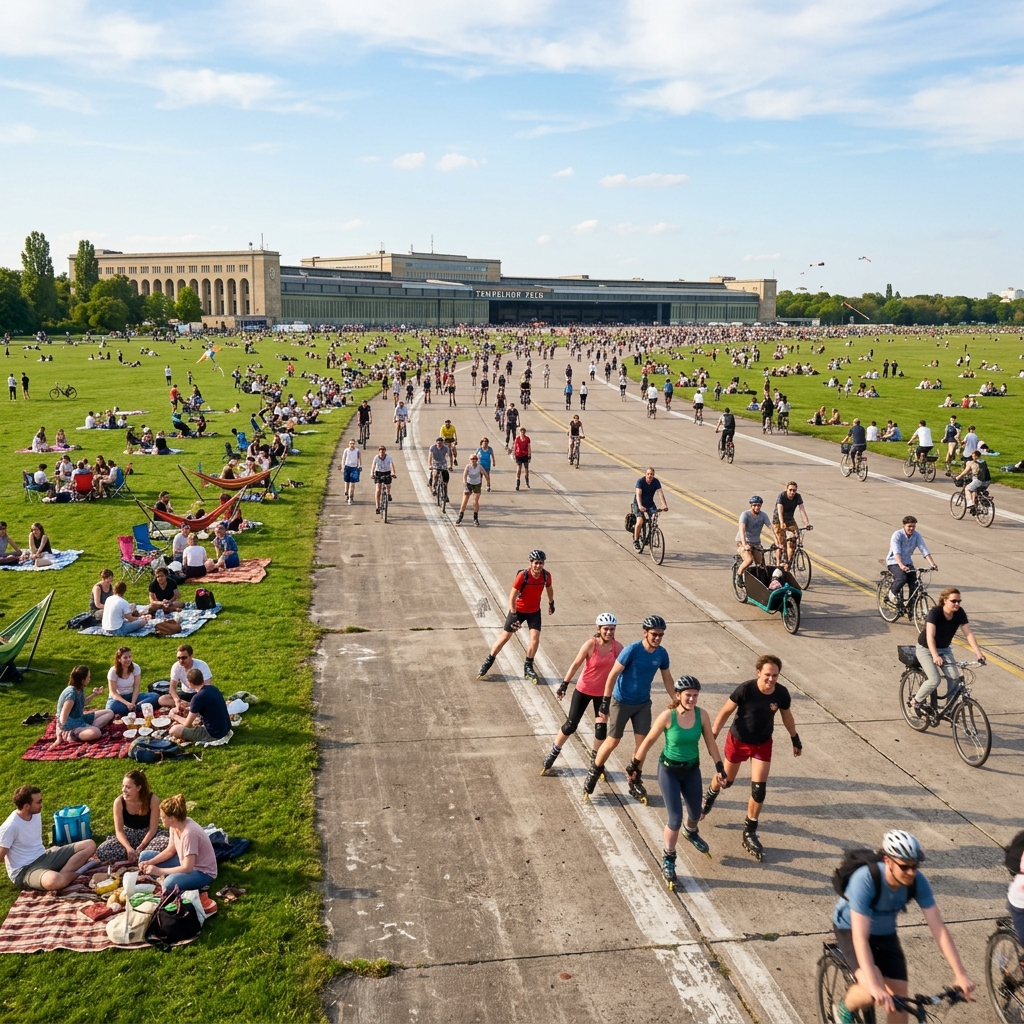
Step through the iron perimeter gates of Tempelhofer Feld on a breezy summer evening, and the sensory disorientation is immediate. In the middle of landlocked, densely populated central Europe, you are suddenly standing before an unbroken, 355-hectare sea of prairie grasses and parallel two-kilometer asphalt runways stretching straight toward the horizon. The horizon line is completely flat, the sky feels impossibly vast, and the soundscape consists of whirling skate wheels, wind whipping through canvas traction kites, and the distant melody of acoustic guitars.
Covering an expanse larger than the principality of Monaco or New York’s Central Park, Tempelhofer Feld is the largest open recreational space in central Berlin. But this is no ordinary urban park. It is a monumental landscape that witnessed the dawn of aviation, served as the ideological aerodrome of the Third Reich, anchored the greatest humanitarian airlift in world history, and was ultimately saved from commercial developers by a triumphant grassroots democratic revolution.
From Prussian Parades to Orville Wright: The Birth of Flight
Long before airplanes existed, this flat glacial plateau was used for centuries as military training grounds and parade fields by Prussian monarchs and Kaiser Wilhelm I. In the early 20th century, however, Tempelhof became the testing ground for the dawn of human flight.
In September 1909, American aviation pioneer Orville Wright brought his wooden biplane to Tempelhofer Feld. Before an estimated crowd of 350,000 roaring Berliners, Wright soared into the skies, shattering world records by staying aloft for an hour and climbing to a then-unheard-of altitude of 172 meters. By 1923, the city of Berlin officially designated the field as its primary commercial airport (Zentralflughafen Tempelhof), establishing the world’s first passenger airline hub with regular international scheduled flights.
The Monolith: Sagebiel’s "Mother of All Airports"
In 1936, the Nazi regime launched an audacious reconstruction of Tempelhof as the majestic aerial gateway to Adolf Hitler and Albert Speer's projected world capital, Welthauptstadt Germania. Designed by architect Ernst Sagebiel, the monumental terminal was conceived on a colossal scale:
- The Crescent Architecture: Constructed between 1936 and 1941, the limestone-clad terminal forms a gentle, sweeping 1.2-kilometer curve—making it the longest contiguous building in Europe and one of the largest architectural structures on the planet. Famed British architect Sir Norman Foster later aptly christened it "the mother of all airports."
- Cantilevered Canopy: The terminal featured a revolutionary 40-meter-deep overhanging steel roof that sheltered arriving airliners, allowing passengers to disembark directly into the terminal without being exposed to rain or snow.
- Wartime Shadows: Beneath the polished limestone facades lay a labyrinth of subterranean railroad tunnels, bomb shelters, and assembly hangars where thousands of forced laborers were coerced into manufacturing Weser Flugzeugbau fighter aircraft for the Luftwaffe during the Second World War.
The Berlin Airlift: The Candy Bombers of 1948–1949
Tempelhof’s darkest military origins were dramatically redeemed during the opening crucible of the Cold War. On June 24, 1948, the Soviet Union launched the Berlin Blockade, severing all highway, railway, and canal access between West Germany and West Berlin in an effort to starve the capitalist enclave into submission.
Refusing to surrender the city, the Western Allies mounted the Berlin Airlift (Berliner Luftbrücke). Operating around the clock for eleven grueling months, American and British pilots flew continuous streams of Douglas C-47 Skytrains and C-54 Skymasters through narrow aerial corridors, touching down at Tempelhof every ninety seconds. They hauled over 2.3 million tons of flour, dried potatoes, medical supplies, and coal to keep 2.2 million West Berliners alive through a brutal winter.
It was here that American pilot Lieutenant Gail Halvorsen earned immortality as the "Candy Bomber" (Rosinenbomber). Tying miniature handkerchief parachutes to candy bars, chewing gum, and chocolate rations, Halvorsen wiggled his aircraft’s wings before landing, dropping treats to crowds of cheering German children clustered along the runway fences. The operation permanently transformed former wartime enemies into enduring democratic allies.
Tempelhofer Feld is not open 24/7; the park follows strict seasonal hours and closes at dusk. Approximately fifteen minutes before sunset, park sirens sound across the runways, and security patrols guide visitors toward the exits before the heavy iron gates are padlocked. Plan your arrival via the Oderstraße entrance in Neukölln if you want to explore the vibrant Allmende-Kontor community garden and enjoy relaxed picnic vibes. If you are bringing roller skates, longboards, or traction kites, enter via Tempelhofer Damm (S+U Tempelhof) for immediate access to the wide, smooth northern runway. Because the open field lacks tree shade and catches powerful westerly winds, always pack a windbreaker and plenty of water.
The 2014 Rebellion: The People Save the Field
On October 30, 2008, the final commercial propeller flight departed Tempelhof, and the airport was officially decommissioned. When the Berlin Senate opened the perimeter fences to the public in May 2010, the field instantly became a beloved urban playground.
However, corporate real estate interests and city planners soon unveiled aggressive plans to build luxury high-rises, commercial office parks, and a monumental central library along the perimeter of the field. Berliners viewed this as the commercial destruction of their most sacred democratic space.
In an extraordinary act of civic defiance, the grassroots coalition 100% Tempelhofer Feld collected hundreds of thousands of signatures, forcing a citywide public referendum on May 25, 2014. Despite heavy lobbying from the municipal government, Berlin citizens voted overwhelmingly (64.3%) to enact the ThF-Gesetz—a binding law that strictly bans all commercial development, permanently preserving the entire 355-hectare field as an inviolable public commons for future generations.
What Tempelhofer Feld Is Today: The Urban Oasis
Today, Tempelhofer Feld represents the quintessential bohemian, inclusive soul of modern Berlin:
- Runway Speedway: Six kilometers of pristine tarmac runways are filled with land-sailors, rollerbladers, unicyclists, and longboarders harnessing the unobstructed Atlantic winds.
- Allmende-Kontor Community Garden: Spanning five thousand square meters near the Neukölln boundary, this participatory urban farm features hundreds of raised wooden garden beds, recycled pallet benches, sunflowers, and beehives.
- Wildlife Sanctuary: The expansive central grassland serves as a vital protected habitat for rare ground-nesting birds, particularly the endangered Feldlerche (Eurasian skylark), which nests in the undisturbed center throughout the spring and summer.
- Terminal Tours: While the field is open and free, the massive 1.2-kilometer terminal building can be explored through guided architectural and historical tours operated by Tempelhof Projekt GmbH, taking visitors into the underground air-raid shelters, radar towers, and historic baggage halls.
Visitor Logistics and Entrances
Tempelhofer Feld has three primary public entry points, each easily accessible via public transit:
- Tempelhofer Damm Entrance (West): Take U-Bahn line U6 or Ringbahn lines S41, S42, S45, S46 to S+U Tempelhof. Best for runway speed sports and immediate access to the western tarmac.
- Columbiadamm Entrance (North): Take U-Bahn line U6 to Platz der Luftbrücke (near the 1951 Berlin Airlift Memorial) or bus 104 to Golßener Straße. Ideal for sports courts and viewing the monumental terminal facade.
- Oderstraße Entrance (East): Take U-Bahn line U8 to Leinestraße or Boddinstraße in Neukölln. The preferred entrance for community gardens, picnics, and sunset socializing.
- Admission & Amenities: Entry to the park is completely free. Dedicated dog-run enclosures, public barbecue zones, clean restroom containers, and seasonal kiosk drinks are available throughout the grounds.
Comments