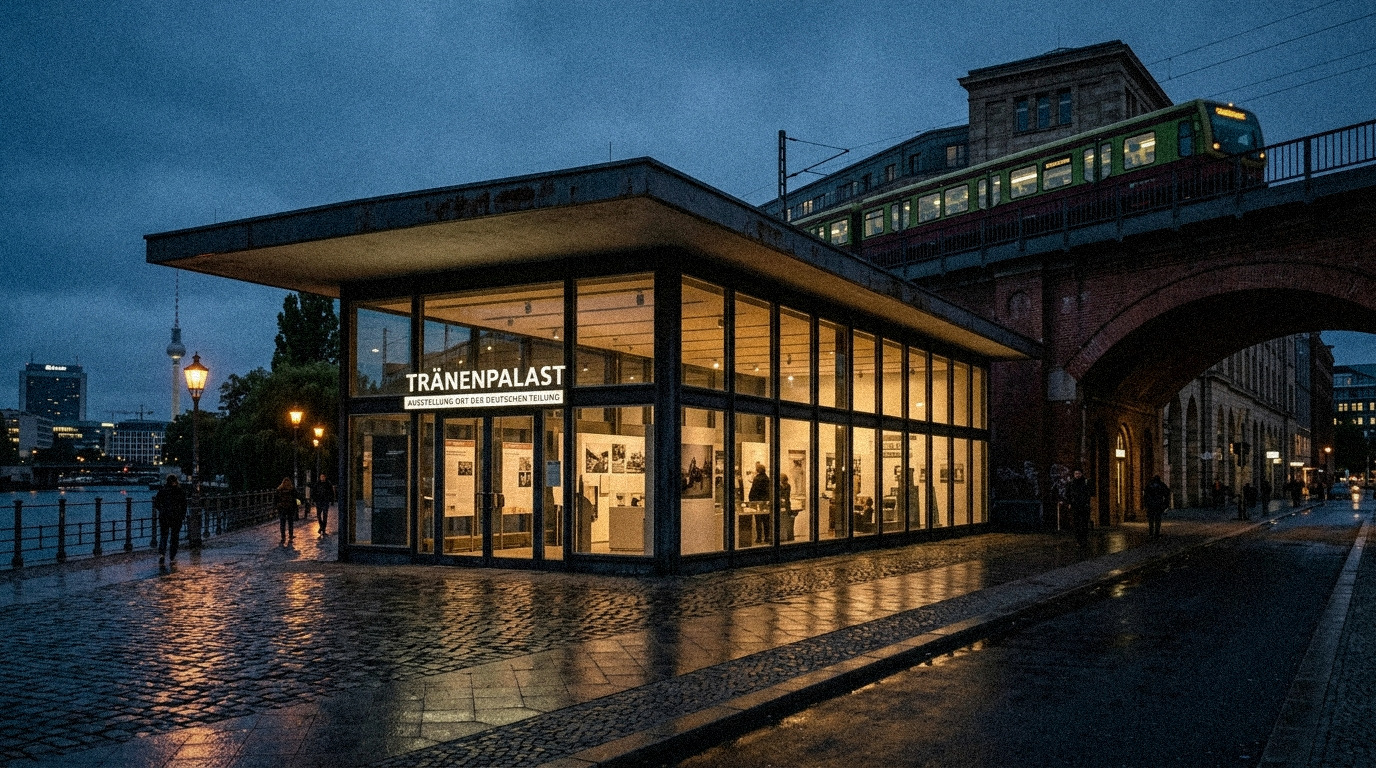
On an overcast autumn evening in 1978, a Western visitor walking down the promenade of Reichstagufer toward Bahnhof Friedrichstraße would have witnessed a stark daily ritual of the Cold War. Through the floor-to-ceiling glass facade of a glowing mid-century pavilion, silhouettes stood frozen in desperate, prolonged embraces. Hands pressed against cold glass. Muffled sobs echoed over the low hum of idling diesel engines and the rhythmic clatter of elevated S-Bahn trains overhead. Armed East German border guards watched with practiced indifference.
This was the Tränenpalast—the "Palace of Tears." For twenty-eight years, this unassuming glass-and-steel cube beside the Spree River served as the primary departure terminal for travelers crossing from communist East Berlin back into the West. To millions of divided Germans, it was not merely an infrastructural checkpoint; it was an emotional purgatory where families, lovers, and lifelong friends were forced to part, having no idea whether months, years, or decades would pass before they might see each other again.
The Friedrichstraße Paradox: An Underground Border in the Heart of the City
When the German Democratic Republic (GDR) abruptly sealed the borders around West Berlin on August 13, 1961, the regime faced a massive logistical dilemma at Bahnhof Friedrichstraße. Located entirely in East Berlin’s Mitte district, this Victorian iron-and-glass transit hub had long been the busiest junction in the city.
To maintain transit access between different sectors of West Berlin, East Germany permitted West Berlin S-Bahn and U-Bahn trains to continue running beneath East Berlin soil—shuttering intermediate East German stops into heavily armed "Ghost Stations" (Geisterbahnhöfe). Friedrichstraße became the sole subterranean transfer point where Western passengers could switch lines without legally entering the GDR.
However, for West Germans and foreign visitors who had secured day visas to visit family in East Berlin, returning to the West required exiting the city and passing back into the Western transit system. The crush of departing travelers overwhelmed the old station concourse. In response, the East German Ministry of Transport and the Stasi commissioned an entirely new, dedicated departure terminal.
Architecture of Deceptive Transparency: Horst Lüderitz’s Glass Cube
Erected in 1962 and designed by Deutsche Reichsbahn architect Horst Lüderitz, the Tränenpalast is a striking example of post-war International Style modernism. It features a sweeping flat roof with exaggerated eaves, slender steel supports, and expansive, floor-to-ceiling glass curtain walls that flood the interior with natural light.
This transparent, airy aesthetic was a deliberate exercise in political and psychological misdirection:
- The Modern Facade: To international visitors and foreign diplomats, the luminous glass pavilion projected an image of an efficient, progressive, and confident socialist state—resembling a chic airport lounge rather than a border fortification.
- The Spatial Trap: Once inside, that illusion evaporated immediately. The interior layout was engineered by security specialists to isolate, disorient, and intimidate travelers. Acoustic dampening materials deadened conversations to whispers. High partition walls blocked sightlines, funneled human traffic through serpentine switchbacks, and ensured that individual travelers could never see what awaited them around the next corner.
- Segregated Streams: East German authorities strictly separated travelers into distinct, isolated corridors based on citizenship: West Berliners, citizens of the Federal Republic (West Germany), and international passport holders each walked through separate checkpoints.
The Stasi Gauntlet: One-Way Mirrors and Interrogation Cabins
Passing through the Tränenpalast was an exercise in bureaucratic suspense. East German citizens—forbidden from traveling to the West under penalty of imprisonment—were forced to halt at the outer entrance doors. Only travelers with valid Western exit documents could step across the threshold.
Once inside, travelers surrendered all semblance of privacy as they entered the notorious Passport Control Cabins (Passkontrollkabinen):
- Elevated Isolation: The traveler stood inside a narrow, claustrophobic wooden cubicle. The border control officer—an undercover member of the Stasi’s Department VI—sat on an elevated platform behind bulletproof glass, forcing the traveler to gaze upward into harsh fluorescent glare.
- Optical Surveillance: A system of angled mirrors and one-way glass allowed the officer to examine the traveler's shoes, posture, and facial twitches without being observed. Hidden foot pedals controlled locking mechanisms on the cabin doors.
- Pneumatic Intelligence Tubes: Suspect passports were inserted into pneumatic tubes and whisked into subterranean Stasi archives beneath the station, where intelligence officers cross-referenced names against databases of defectors, activists, and dissidents.
Beyond passport control lay the customs hall, where travelers were subjected to intrusive luggage inspections, mandatory currency surrender declarations, and body searches before finally descending the damp, dimly lit concrete staircase onto the S-Bahn platform heading toward West Berlin.
Admission to the Tränenpalast permanent exhibition is 100% free, and free multimedia audio guides are provided in multiple languages at the front desk. Make sure to walk inside the authentic, preserved wooden passport control cabin in the center of the hall: stepping inside that cramped booth and looking up at the officer's mirrored window conveys the claustrophobic dread of the Cold War border better than any history textbook ever could.
From Teardrops to Techno: The Fight for Preservation
When the Berlin Wall collapsed on November 9, 1989, the border bureaucracy at Friedrichstraße disintegrated almost overnight. The iron gates swung open, the Stasi officers cleared out their surveillance booths, and the Tränenpalast became functionally obsolete within months.
During the tumultuous 1990s, when unified Berlin was in a rush to sweep away reminders of division, the pavilion faced imminent demolition to make way for commercial office towers. Instead, an enterprising cultural collective intervened, turning the empty glass hall into a beloved nightclub, cabaret venue, and theater space named Tränenpalast. For over a decade, the room that had echoed with painful goodbyes reverberated with comedy, jazz, and underground electronic beats.
Recognizing its irreplaceable historical significance, the City of Berlin granted the building heritage landmark status. In September 2011, the Stiftung Haus der Geschichte der Bundesrepublik Deutschland (House of History Foundation) opened its permanent museum exhibition: "BorderExperience: Everyday Life in Divided Germany."
Actionable Logistics: Planning Your Visit
The Tränenpalast sits immediately adjacent to Friedrichstraße station in the historic heart of Berlin:
- Location & Getting There: Reichstagufer 17, 10117 Berlin. Take the S-Bahn (S1, S2, S25, S26, S3, S5, S7, S9), U-Bahn (U6), or regional trains (RE1, RE2, RE7, RE8) directly to Bahnhof Friedrichstraße. Exit toward the Reichstagufer / Spree river promenade; the glass pavilion sits right beside the station viaduct.
- Opening Hours: Tuesday through Friday: 9:00 AM – 7:00 PM; Saturday and Sunday: 10:00 AM – 6:00 PM. Closed Mondays.
- Admission: Free admission. No advance tickets required; visitors can walk directly into the exhibition.
- Accessibility: The entire exhibition hall and restroom facilities are fully barrier-free and wheelchair accessible.
- Nearby Historical Pairings: Combine your visit with a short walk west along the Spree to the Reichstag and Brandenburg Gate, or stroll south along Friedrichstraße to Checkpoint Charlie.
Comments