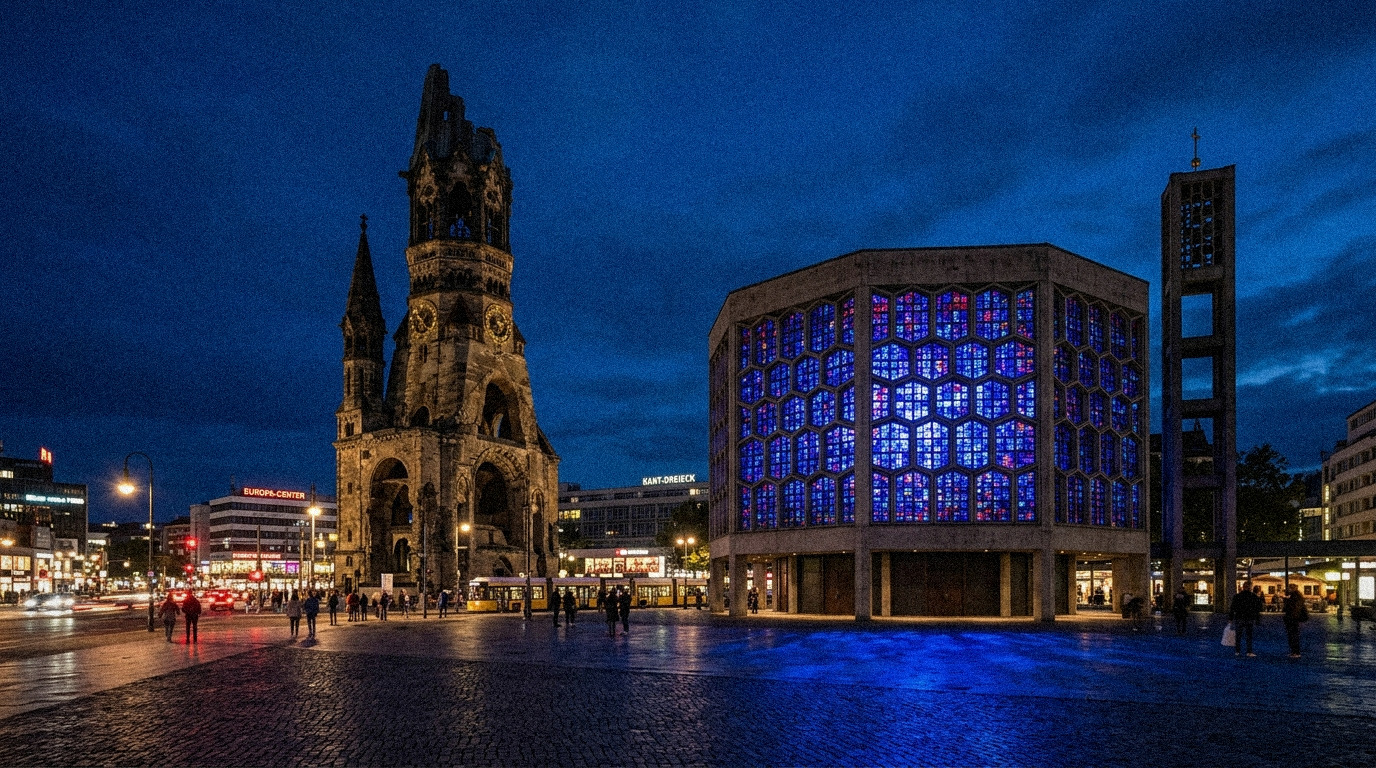
Standing in the bustling heart of Breitscheidplatz at the western terminus of the Kurfürstendamm, the visual shock is immediate. Amid the glass-and-steel shopping arcades, honking double-decker buses, and neon commercial signage rises a blackened, jagged mountain of stone. Its central steeple, once the tallest spire in the imperial capital, terminates abruptly in a jagged, hollow fracture sixty-eight meters high, looking like a severed limb clawing at the Berlin sky.
Berliners, who possess an incurable gift for irreverent gallows humor, have long called it "der hohle Zahn"—the hollow tooth. Formally known as the Kaiser-Wilhelm-Gedächtniskirche (Kaiser Wilhelm Memorial Church), this shattered ruin is not an abandoned demolition site. Flanked by an extraordinary ensemble of honeycomb-concrete modernist structures glowing with twenty thousand blocks of deep cobalt-blue stained glass, the church is West Berlin’s most iconic architectural landmark and one of the world's most poignant memorials to the catastrophe of total war.
Imperial Megalomania: Franz Schwechten’s Neo-Romanesque Fortress
The church’s origins reflect the triumphalist ego of the late German Empire. Consecrated on September 1, 1895, the original church was commissioned by Kaiser Wilhelm II to honor his grandfather, Kaiser Wilhelm I, who had unified Germany following the Franco-Prussian War of 1870–71.
Architect Franz Schwechten was instructed to design an imposing monument of imperial dynastic power. He responded with a colossal, five-towered Neo-Romanesque fortress constructed of dense sandstone:
- The 113-Meter Spire: The main bell tower soared 113 meters (370 feet) into the air, making it the highest architectural summit in Berlin.
- Imperial Mosaics: The interior was coated in over 2,700 square meters of glittering Venetian gold-leaf mosaics depicting the Hohenzollern monarchs marching alongside Charlemagne and Roman emperors.
- The Bronze Bells: The belfry held five massive bronze bells cast from captured French cannon barrels, so heavy that their reverberations reportedly shook surrounding apartment windows.
November 23, 1943: The Night the Spire Burned
The imperial monument stood for less than fifty years. On the freezing night of November 23, 1943, the British Royal Air Force launched a devastating air raid targeting western Berlin. High-explosive and incendiary bombs struck the church, collapsing the main roof and setting the central timber spire ablaze. The fire burned with such ferocity that the bells crashed through melting beams into the crypt below.
Further bombing raids in 1944 and ferocious artillery battles in April 1945 tore away the choir, transept, and side towers. When the smoke cleared over conquered Berlin, only the ground-level memorial vestibule and the shattered stump of the main western bell tower remained standing amidst vast fields of smoking rubble.
The 1957 Battle of Breitscheidplatz: Ruin vs. Tabula Rasa
In the mid-1950s, as the "Economic Miracle" (Wirtschaftswunder) fueled the feverish reconstruction of West Berlin, municipal planners viewed the blackened ruin as an unsightly, morbid embarrassment right in the center of their gleaming new commercial showcase on Kurfürstendamm.
In 1957, the city held an architectural competition to build a modern church. The winning entry by renowned modernist master Egon Eiermann proposed a complete tabula rasa: bulldozing the charred imperial ruin entirely to make way for a pristine, minimalist glass complex.
The proposal sparked a civil uprising among West Berlin citizens. Letters flooded newspaper editorial boards, and passionate protest rallies filled Breitscheidplatz. Berliners fiercely argued that erasing the physical scar would be an act of historical cowardice—an attempt to sweep Nazi aggression and the horrors of wartime destruction under a rug of glossy modernism.
Confronted by public fury, Eiermann executed an inspired, historic compromise. Rather than demolishing the ruin, he integrated the battered 68-meter hollow spire as the spiritual anchor of the entire composition. Around it, he designed a revolutionary modernist ensemble comprising an octagonal nave, a freestanding hexagonal bell tower, a rectangular chapel, and a foyer—pairing the preserved war ruin directly with postwar modernist geometry.
Eiermann and Gabriel Loire: The Cathedral of Cobalt Light
Approaching Eiermann’s new church from the outside, the building appears austere—almost severe. The exterior walls consist of a stark concrete honeycomb grid with thousands of square apertures.
Step through the double acoustic glass entrance doors, however, and traffic noise drops away inside a quiet, blue-lit octagonal hall:
- The Chartres Cobalt Palette: The walls are embedded with 21,292 hand-chipped stained glass blocks crafted by the legendary French master Gabriel Loire at his studio in Chartres. Loire used a thick, faceted dalles-de-verre technique, chiseling the edges of the glass so they refract light like raw gemstones.
- The Blue Symphony: Dominated by a profound, deep cobalt blue reminiscent of the 13th-century clerestories of Chartres Cathedral, the glass is flecked with flashes of ruby red, emerald green, and amber gold. As daylight shifts outside, the interior glows with an intense, meditative luminosity that seems to detach the sanctuary from physical reality.
- The Floating Christ: Suspended high above the altar is Karl Hemmeter’s monumental golden brass figure of the Resurrected Christ, with arms outstretched in benediction and mourning.
Do not just photograph the exterior from Breitscheidplatz. Step inside the Gedenkhalle (Memorial Hall) located inside the ground floor of the ruined old tower (free admission). Here you can gaze directly up into the exposed, jagged ceiling of the ruptured steeple, view the surviving 1890s imperial mosaics, and see two notable wartime artifacts of reconciliation: the Stalingrad Madonna and the Coventry Cross of Nails.
Artifacts of Reconciliation: The Stalingrad Madonna and Cross of Nails
The Memorial Church functions as a global shrine to international reconciliation, marked by two historical artifacts preserved in the Memorial Hall:
- The Stalingrad Madonna: On Christmas Eve 1942, surrounded by Soviet forces in a freezing dirt bunker during the Battle of Stalingrad, a German army physician and pastor named Kurt Reuber drew a charcoal sketch on the back of a captured Soviet military map. It depicts the Virgin Mary wrapping her shawl around the Christ child, accompanied by the handwritten words: "Licht, Leben, Liebe" (Light, Life, Love). Reuber gave the sketch to a wounded officer flown out on the last medical transport plane; Reuber died in a Soviet prisoner-of-war camp in 1944. Today, his original sketch hangs in the Memorial Hall as a universal symbol of human tenderness and shared grief amidst the horrors of war.
- The Coventry Cross of Nails: In November 1940, the German Luftwaffe firebombed the English city of Coventry, gutting its historic 14th-century cathedral. Out of the ashes, three large medieval iron roof nails were welded together into a cross, sparking an international movement of forgiveness. In 1987, Coventry Cathedral presented a replica Cross of Nails to the Memorial Church, cementing a solemn bond of peace between two cities scarred by the same war.
Actionable Logistics: Planning Your Visit
The Kaiser Wilhelm Memorial Church is located on Breitscheidplatz between Kurfürstendamm, Tauentzienstraße, and Budapester Straße:
- Getting There: Take the U-Bahn (U2, U9) or S-Bahn (S3, S5, S7, S9) directly to Zoologischer Garten station, which is a 3-minute walk south. Alternatively, take the U-Bahn (U1, U9) to Kurfürstendamm station.
- Opening Hours:
- New Church Sanctuary: Open daily from 9:00 AM to 7:00 PM. Organ meditations and evening services are held regularly.
- Old Tower Memorial Hall (Gedenkhalle): Open daily from 10:00 AM to 6:00 PM.
- Admission & Tours: Entry to both the new church and the historic memorial ruin is completely free of charge. Donations for the ongoing structural preservation of the ruined tower are gratefully accepted. 30-minute guided tours are conducted daily at 1:00 PM, 2:00 PM, and 3:00 PM (nominal €5 fee).
- Photography Etiquette: Photography is permitted without flash or tripod; maintain quiet and respectful decorum inside the sanctuary during prayer or musical rehearsals.
Comments