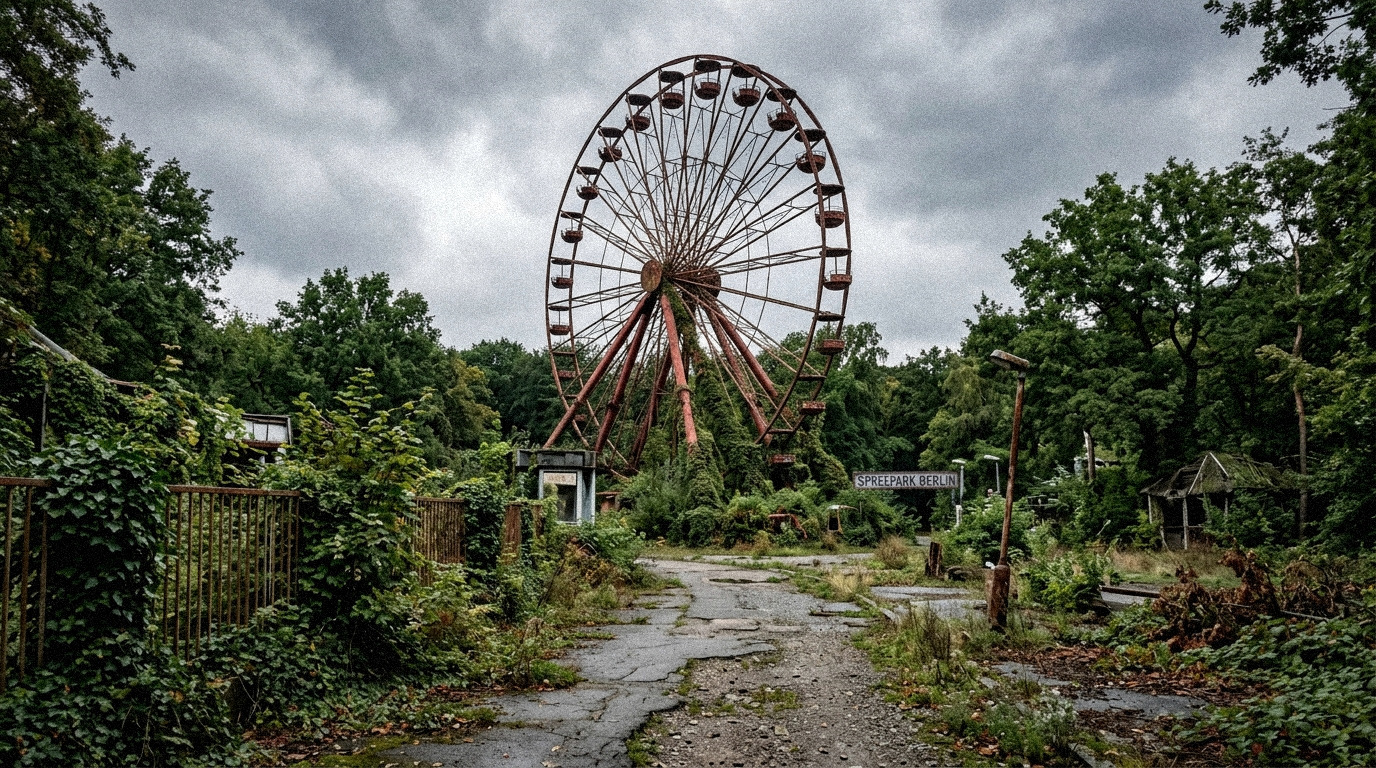
Deep in the damp woodlands of Plänterwald in East Berlin, towering above oak trees and tangled brambles along the banks of the River Spree, sits a massive skeleton of rusted crimson steel: a 40-meter-tall Ferris wheel. For nearly twenty years, following the park’s abrupt bankruptcy in 2001, the wheel stood in eerie silence, occasionally creaking and revolving unpowered in the autumn wind while toppled fiberglass tyrannosaurs, flooded swan boats, and rotting roller coaster tracks decayed in the underbrush below.
This is Spreepark—formerly Kulturpark Plänterwald. Its story is not just a fascinating study in post-reunification urban archaeology; it is one of the wildest, most tragic real-life melodramas in modern European history, featuring socialist state propaganda, a reckless carnival showman, bankruptcy, international flight to South America, and a catastrophic cocaine smuggling operation.
The Socialist Showcase: Kulturpark Plänterwald (1969–1989)
The park opened on October 4, 1969, timed specifically to celebrate the 20th anniversary of the German Democratic Republic (GDR). As East Germany’s only permanent amusement park, Kulturpark Plänterwald was an immediate national sensation. In a walled nation where citizens could not travel to Western leisure attractions, the park was a crucial showcase of socialist modernity and leisure.
At its peak, up to 1.7 million visitors a year poured through the gates. Families queued for hours to ride the bumper cars, the Spree-Blitz coaster, the log flume, and the giant Ferris wheel—which offered panoramic views extending across East Berlin to the iconic Fernsehturm at Alexanderplatz. It was an orderly, joyful fixture of East German childhood memories, complete with soft-serve ice cream stands, brass bands, and pioneer rallies.
Reunification, Privatization, and Norbert Witte
When the Berlin Wall fell in November 1989, the entire economic landscape collapsed overnight. In 1991, the newly unified Berlin Senate sought to privatize the amusement park. They leased the 30-hectare site to a West German carnival operator named Norbert Witte and his company, Spreepark GmbH.
In their haste, municipal authorities failed to perform thorough due diligence. Witte possessed a notoriously turbulent past in the West German carnival circuit; a decade earlier, in 1981, his carnival machinery in Hamburg had suffered a catastrophic collision that killed seven people and injured fifteen, resulting in a manslaughter conviction.
Witte had grand ambitions for Spreepark. He invested millions transforming the socialist fair into an American-style theme park with an English village, a Wild West town, and elaborate animatronics. But the business model was fatally flawed:
- The Ecological Sanctuary Conflict: In the late 1990s, the surrounding Plänterwald forest was officially designated a protected landscape conservation area (Landschaftsschutzgebiet). Environmental authorities strictly forbade Witte from building dedicated visitor parking lots, leaving visitors to battle for parking in residential neighborhoods miles away.
- Plunging Attendance: High ticket prices combined with fierce competition from modern Western theme parks caused attendance to crater from 1.5 million in 1995 to barely 400,000 by 2001.
- Insolvency: Drowning in debts of over €11 million, Spreepark shut its gates forever in the autumn of 2001, leaving the property in legal limbo.
The Peruvian Escape and the Cocaine Masts
What happened next sounds like a surreal Hollywood crime thriller. In January 2002, Witte covertly dismantled six of the park’s premier attractions—including the "Flying Carpet," the "Fluch des Pharao," the "Butterfly," and the "Spider"—crammed them into 20 transatlantic shipping containers, and shipped them to Lima, Peru, claiming they were merely traveling abroad for maintenance and a temporary exhibition.
Once in Peru, Witte and his family attempted to open a new carnival called "Lunapark" in Lima. But the Peruvian venture was a financial disaster: custom duties drained their remaining cash, equipment malfunctioned, and the park collapsed. Facing absolute ruin, Witte turned to international narcotics trafficking.
In November 2003, Peruvian and German anti-narcotics agents intercepted a shipping container bound back for Germany. Hidden inside the heavy hollow steel support masts of the "Flying Carpet" ride was 167 kilograms of pure cocaine with a street value exceeding $40 million. Norbert Witte was arrested in Germany and sentenced to seven years in prison; his 23-year-old son, Marcel, was convicted in Peru and endured over a decade of brutal conditions in the infamous Sarita Colonia prison before his release.
The interior of Spreepark is closed to unguided wandering and strictly monitored by security—trespassing fences is actively prosecuted. However, the historic Eierhäuschen, a stunning 19th-century riverside inn inside the park, has been completely restored by the city and is open for dining, coffee, and contemporary art exhibitions! From the terrace of Eierhäuschen, you have unobstructed, legal views of the historic Ferris wheel and walking trails through Plänterwald.
Decay, Urbex Mythology, and the Grün Berlin Revival
Back in Berlin, the abandoned park sat untouched for fifteen years, slowly reclaimed by nature. Plänterwald’s damp microclimate turned fiberglass dinosaurs into mossy beasts. Rust crept across the Ferris wheel, which engineers deliberately left unbraked so wind forces wouldn't topple the massive structure. It became a global mecca for urban explorers, street artists, and filmmakers (featuring prominently in the 2011 action film Hanna).
Recognizing that the blighted parcel could not sit abandoned forever, the State of Berlin repurchased the lease in 2014 and entrusted stewardship to Grün Berlin GmbH, the municipal developer responsible for Tempelhofer Feld and the Park am Gleisdreieck.
Rather than bulldozing the site into a generic public lawn or selling it to commercial investors, Grün Berlin initiated a visionary transformation into an integrated Art, Culture, and Nature Park. Under this plan:
- Ferris Wheel Preservation: The 40-meter Ferris wheel is being fully dismantled, sandblasted, structurally re-engineered, and fitted with modern open gondolas to spin once more as an interactive kinetic art sculpture.
- Ecological Succession: The wild pioneer plants, rare mosses, and bird habitats that flourished during the twenty years of human absence are being actively protected alongside historical ruins.
- Public Walking Loops: A network of elevated wooden boardwalks allows visitors to traverse the historic site without trampling fragile forest soils.
Actionable Logistics: Visiting the Spreepark Area
Everything you need to know when exploring the Plänterwald riverfront:
- Location: Kiehnwerderallee 1-3, 12437 Berlin (Treptow-Köpenick).
- Getting There: Take the S-Bahn (S8, S9, S41, S42) to S-Bahnhof Plänterwald, followed by a scenic 15-minute walk through the forested parkland toward the Spree riverbank.
- The Eierhäuschen & Art Space: The restored historic restaurant and cultural venue is open Wednesday through Sunday, offering fresh seasonal cuisine, riverside drinks, and regular art talks.
- Guided Tours: Grün Berlin organizes seasonal docent-led walking tours around the perimeter of the redevelopment site detailing the history and future plans. Booking in advance via gruen-berlin.de is essential.
Comments