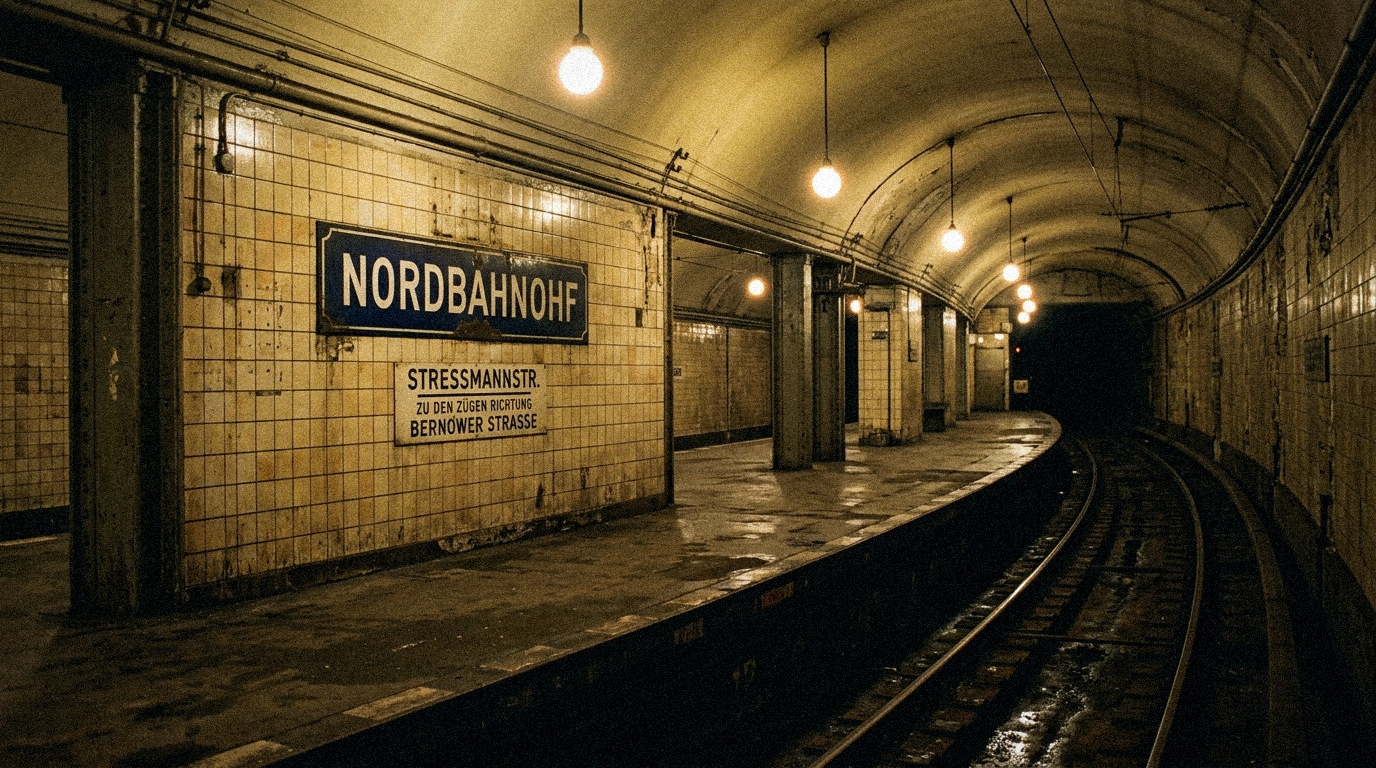
For twenty-eight years, between August 13, 1961, and November 9, 1989, millions of West Berliners took part in one of the most surreal daily commutes in modern urban history. As their subway trains rumbled along the underground lines connecting the northern and southern sectors of West Berlin, the train would abruptly decelerate to a cautious crawling pace of 15 kilometers per hour. The electric lights inside the carriages would dim, and passenger conversations would dwindle into uneasy silence.
Outside the train windows, the train glided through cavernous subterranean stations bathed in feeble, jaundiced incandescent bulbs. Through the dusty glass, commuters caught glimpses of vintage 1930s enamel station signs, peeling advertisements from a bygone era, and heavily armed East German border guards standing stone-faced behind concrete slit bunkers and steel observation posts. These were Berlin’s Geisterbahnhöfe—the legendary "Ghost Stations."
The Geography of Division: How Subway Lines Traversed the Iron Curtain
When the Socialist Unity Party of East Germany erected the Berlin Wall in August 1961, they successfully severed the city above ground. Barbed wire, concrete slabs, watchtowers, and dog runs divided streets, squares, and families overnight. But underground, Berlin possessed one of the most intricate and tightly interwoven rapid transit networks in the world, engineered decades earlier for a unified metropolis.
Two major West Berlin U-Bahn lines (today’s U6 and U8), as well as the north-south subterranean S-Bahn tunnel, had routes that began in West Berlin, passed directly beneath the historical city center of East Berlin (Mitte), and emerged back out into West Berlin territory. Severing these tracks entirely would have paralyzed public transit across the Western sectors.
A bizarre, pragmatic Cold War compromise was forged: the East German authorities permitted West Berlin trains to traverse the eastern tunnels, provided that the trains never stopped. In exchange, the West Berlin transit authority (BVG) paid East Germany millions of West German Deutsche Marks annually in transit fees—hard currency that the cash-starved GDR regime desperately craved.
Sealed Entrances, Barricades, and Armed Guards
Sixteen stations scattered across East Berlin were closed to the public overnight. Street-level staircases and subway entrances were bricked shut or covered with heavy corrugated iron sheets, their above-ground signage unscrewed to erase their very existence from official East Berlin maps.
Underneath, the stations were transformed into heavily fortified border installations:
- The Bunkers: Guard posts (Postenstände) with bulletproof glass and narrow firing slits were built on the platforms, manned 24 hours a day by armed border troops (Grenztruppen).
- The Barrier Walls: Brick and steel partitions were erected across walkways to prevent any East German citizen who entered a sewer or tunnel from accessing the tracks.
- Track Spikes and Tripwires: The track beds were lined with electrified alarm wires and carpet-like metal spike mats (Stachelmatten) designed to incapacitate anyone attempting to sprint toward a slow-moving Western train.
- The Lone Exception: Bahnhof Friedrichstraße: Friedrichstraße station served as the sole underground border crossing. West Berliners could change between lines on isolated platforms, or pass through the notorious "Tränenpalast" (Palace of Tears) checkpoint into East Berlin.
The East German border guards assigned to the ghost stations were selected from politically vetted units, but they were never stationed alone. They were always deployed in pairs to keep mutual watch and prevent defections, and their identities were frequently rotated so guards could not build mutual escape plans.
Daring Escapes Through the Subterranean Void
Despite the lethal risks, the ghost stations were magnets for East Berliners desperate for freedom. Between 1961 and 1989, numerous daring escape attempts were mounted through the subterranean labyrinth.
Some defectors squeezed through forgotten ventilating shafts or pried open sewer grates leading into the U-Bahn tunnels, timing their leaps onto the external couplers or footboards of passing Western trains as they accelerated out of the station. In 1962, a tunnel nicknamed "Tunnel 29" was dug by university students from the basement of a factory on Schönholzer Straße into a residential cellar near the border, successfully liberating twenty-nine people right beneath the noses of the Stasi secret police.
Tragically, not all attempts succeeded. Guards had orders to shoot escapees, and multiple escape attempts ended in gunfire in the claustrophobic darkness of the tunnels.
The Fall of the Wall and the Nordbahnhof Exhibition Today
When the Berlin Wall collapsed in November 1989, the reunification of the transit network was one of the first and most emotional milestones. Stations that had stood in pitch darkness and silence for nearly three decades were cleared of razor wire, power was restored to long-dead fluorescent tubes, and trains opened their doors once again. Within months, the ghostly silence of the stations was replaced by the clatter of commuters.
Today, you can experience this extraordinary chapter of Cold War history firsthand at the Nordbahnhof S-Bahn station. Located on the mezzanine level of the station, the Berlin Wall Foundation operates a permanent, free public exhibition titled "Border Stations and Ghost Stations in Divided Berlin" (Grenz- und Geisterbahnhöfe).
The exhibition features original photographs, archival maps, personal accounts of defectors and guards, and traces of the former brick barrier lines embedded into the floor. It is one of the most haunting and evocative Cold War memorials in the entire city, located directly on the active transit network.
Actionable Takeaways: Visiting the Nordbahnhof Memorial
To explore this subterranean history firsthand, here is how to visit the Nordbahnhof exhibition:
- How to Get There: Take the S-Bahn (S1, S2, S25, or S26) or the M10 tram directly to Berlin Nordbahnhof.
- Exhibition Location: Inside the station mezzanine intermediate level, connecting the street entrance at Invalidenstraße with the S-Bahn platforms.
- Admission & Hours: Admission is completely free! The exhibition is accessible during normal S-Bahn operating hours (roughly 4:30 AM to 1:30 AM daily).
- Suggested Walking Pairing: After exploring the exhibition, walk five minutes east along Bernauer Straße to visit the open-air Berlin Wall Memorial (Gedenkstätte Berliner Mauer), which preserves the full border strip, watchtowers, and documentation center.
Comments