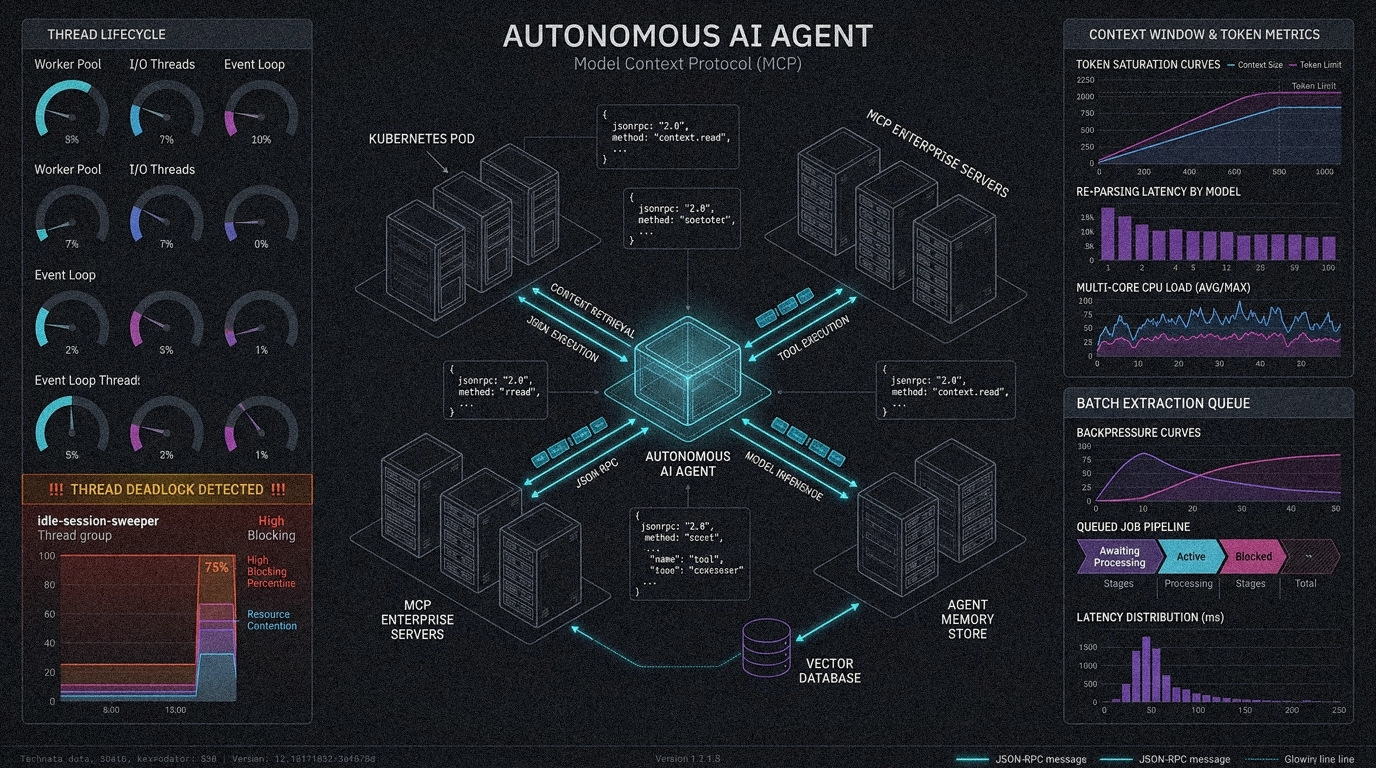
Deploying Model Context Protocol (MCP) servers in continuous production introduces distinct operational requirements around thread lifecycles, operating system locks, and CPU overhead.
Over six months of operating autonomous AI agents against Wikantik’s dual MCP servers (/knowledge-mcp and /wikantik-admin-mcp), the engineering team analyzed and resolved several edge cases across process shutdown, citation parsing, and schema maintenance.
This review documents those failure modes, their root causes, and the engineering remedies implemented in release 2.4.61.
JVM Process Hangs on Shutdown: Non-Daemon SDK Sweeper Threads
During automated rollouts in early October 2026, deployment scripts (bin/redeploy.sh) periodically encountered an initialization failure. After executing shutdown.sh and launching the new container, the newly booted application reported partial initialization: /knowledge-mcp registered only 10 out of 21 tools, and /api/bundle returned HTTP 503.
Process inspection indicated that the prior JVM instance had failed to terminate despite Tomcat signaling the servlet container to halt. Under the Java Language Specification, a JVM process continues executing as long as any non-daemon thread remains active.
Thread dumps identified that the upstream Model Context Protocol Java SDK instantiated an idle-session sweeper thread configured as a non-daemon thread. The sweeper thread remained in an infinite timed-wait polling loop, blocking clean process termination indefinitely.
Because the initial JVM had not exited, it retained exclusive file descriptor locks on the embedded Apache Jena TDB2 ontology store (tdb.lock). When the new Tomcat container bound to port 8080, Jena TDB2 threw lock-acquisition exceptions, disabling ontology and bundle APIs.
The resolution in milestone 2.4.61 addressed thread lifecycles and deployment scripts:
1. An explicit ServletContextListener now interrupts and shuts down the MCP SDK session sweeper during web application teardown.
2. The Lucene search pool, which previously held non-daemon worker threads for up to 60 seconds after search executions, was converted to daemon threads.
3. bin/redeploy.sh was updated to verify termination of the specific PID and issue a SIGTERM after 30 seconds, preventing secondary processes from starting until file locks are completely released.
AST Re-Parsing CPU Overhead in Citation Resolution
A second operational inefficiency appeared in token projection and citation resolution. In milestone 2.4.60, the Context Bundle API (GET /api/bundle) was extended to calculate precise CommonMark heading anchors (e.g., #storage-tier) for every cited chunk, enabling coding assistants to emit verifiable hyperlinks.
Following deployment, CPU utilization on staging hosts increased significantly, with bundle generation latency rising by 1.6x to 1.8x.
Execution profiling revealed that to calculate the anchor slug for a cited section, the bundle assembler was re-parsing the entire CommonMark Abstract Syntax Tree (AST) of each cited document on every incoming request. If a bundle aggregated eight sections across six extensive design documents, the server performed full AST parse passes across six markdown files per query.
In release 2.4.61, heading anchor resolution was decoupled from on-demand queries. Heading paths and anchor slugs are now extracted once during the page-save lifecycle and maintained in an in-memory Caffeine cache. Subsequent bundle assembly requests retrieve pre-computed anchor mappings directly, returning bundle generation latency to under 20 milliseconds.
Operational Maintenance of Structured YAML Frontmatter
Beyond runtime code defects, managing an agentic knowledge base requires continuous adherence to document metadata schemas.
Wikantik’s structural features—the Cytoscape Page Graph, cluster hub navigation, and heading-aware chunking—depend on structured YAML frontmatter:
---
canonical_id: 01M5K177EHVRQMY5WV135AXZ7D
title: 'Database and Disk Profiling: Findings and Repairs'
cluster: wikantik-development
type: article
status: active
related:
- WikiPerformanceTuning
- HybridRetrieval
---
When human authors create documentation under rapid deadlines, frontmatter declarations are often omitted, cluster names misspelled, or related document links neglected.
To manage schema compliance, Wikantik uses two automated mechanisms:
FrontmatterDefaultsFilter: Generates a standard metadata scaffold if a user saves a markdown document lacking frontmatter.wikantik-extract-cli: An asynchronous extraction pipeline utilizing local Ollama models (gemma4-graph:12b) to identify entity triples and propose cluster assignments.
However, automated extraction has operational trade-offs: during inference surges or Ollama restarts, extraction queues accumulate delay. While automated heuristics provide baseline tags, maintaining semantic integrity across complex domains still requires explicit curator review.
Systems Engineering Takeaway
Protocols like MCP expose web application backends to high-frequency automated consumers. Background worker threads, Abstract Syntax Tree parsing, and external neural dependencies must be managed with strict thread hygiene, pre-computed caching, and defensive process monitoring.
The final article in this series reviews Wikantik's infrastructure roadmap: evaluating the boundaries of single-host deployments and outlining the prerequisites for horizontal multi-node scaling.
Comments