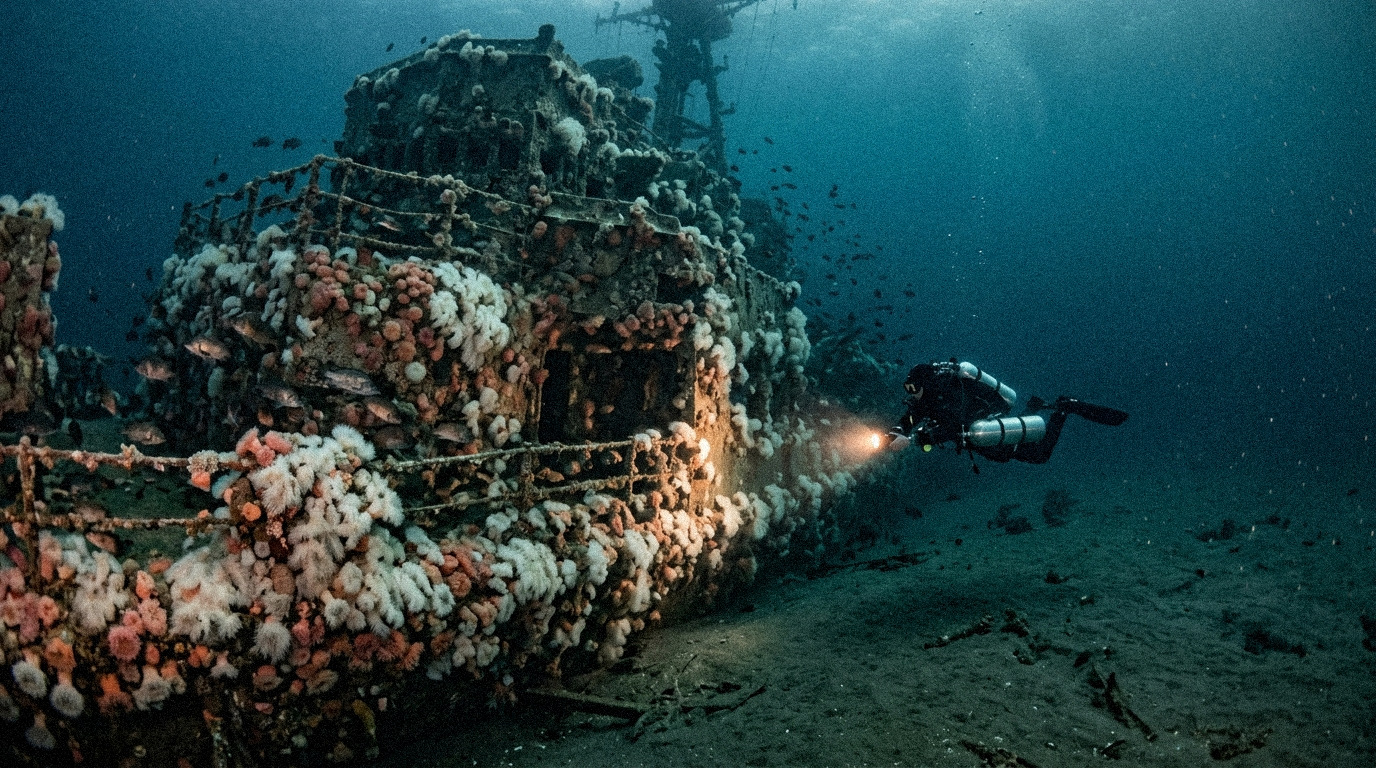
Just two miles off the sun-drenched boardwalks and roller coasters of Mission Beach, the Pacific seafloor plunges into a dim, chilly realm of steel corridors, gun mounts, and blooming invertebrate life. Beneath the rolling surface swells lies Wreck Alley, the West Coast’s premier collection of artificial reefs and intentionally scuttled ships. What was once a desolate expanse of barren sand has transformed into an underwater metropolis where massive naval warships have been reclaimed by the sea.
Rather than rusting away in commercial shipbreaking yards, these decommissioned vessels were systematically cleaned, stripped, and sunk through the tireless efforts of the San Diego Oceans Foundation, the California Department of Fish and Wildlife, and local dive organizations. Today, Wreck Alley offers one of North America's most thrilling technical diving adventures—a haunting world where Cold War anti-submarine destroyers and Prohibition-era Coast Guard cutters have found a second life as thriving marine habitats.
The Premature Plunge of the HMCS Yukon
The largest vessel in Wreck Alley is the HMCS Yukon (DDE 263), a 366-foot Restigouche-class destroyer escort commissioned by the Royal Canadian Navy in 1963. After three decades of Cold War patrol duty, the vessel was decommissioned in 1993 and purchased in 1999 by the San Diego Oceans Foundation for $198,800.
Preparing a 366-foot warship for safe recreational scuba diving is a mammoth engineering feat. Over twelve months, volunteers and commercial salvage crews hauled away thousands of pounds of hazardous materials, asbestos, wiring, and oil sludge. Crucially, cutting torches carved more than 70 diver access holes through the steel bulkhead plates—a process local divers affectionately called "Swiss-cheesing"—guaranteeing that no diver inside the ship would ever be more than 30 feet from an exit hatch.
The scuttling was formally planned as a public spectacle for July 15, 2000, with explosive charges set to drop the ship perfectly upright onto the sandy seabed. But Mother Nature had other plans. On the night of July 14, unseasonal 10-foot Pacific swells began crashing over the low open hatches. Water poured into the hull faster than temporary bilge pumps could exhaust it. Shortly after midnight, hours before the official ceremony and without a single explosive charge detonating, the Yukon rolled over and plunged to the ocean floor, coming to rest at a 90-degree list on her port side in 100 feet of water.
The 90-Degree Vertigo: Diving the Destroyer
That accidental rollover created one of the most psychologically disorienting underwater environments in diving. Because the Yukon rests entirely on her port beam, interior geometry is turned completely sideways:
- Perceptual Tilt: Bulkhead walls are now floors and ceilings, doorways have become vertical elevator shafts, and stairs project horizontally from the side walls. Even experienced divers frequently experience severe spatial vertigo inside the passageways, where your eyes tell your brain to orient toward the tilted steel, but your bubble stream rises toward the true vertical ceiling.
- Depth Profile: The highest point of the starboard hull and radar superstructure sits around 55 to 60 feet below the surface, bathed in ambient greenish sunlight. The main deck drops to roughly 85 feet, while the sandy seafloor beside the port rail bottoms out between 100 and 105 feet.
- The Gun Turrets: Divers descending along the hull can still inspect the intact twin three-inch 50-caliber forward gun mountings, now draped in thick carpets of marine growth.
The interior of the Yukon is a notorious silt trap. While the exterior hull is accessible to any capable Advanced Open Water diver, penetrating the interior corridors requires wreck certification, dual dive lights, a reel line, and disciplined frog-kicking. A single careless flutter kick can kick up decades of fine silt, dropping visibility from 40 feet to zero in seconds. Furthermore, water temperatures at 100 feet hover between 50°F and 54°F even during midsummer—wear a high-quality 7mm wetsuit with an attached hood and gloves, or dive dry.
Beyond the Yukon: The Other Vessels of Wreck Alley
While the Canadian destroyer commands the headlines, Wreck Alley encompasses a multi-layered playground of wrecks, each with its own personality:
- The Ruby E: A 165-foot U.S. Coast Guard patrol cutter launched in 1934 during Prohibition to chase rum-running vessels along the Eastern Seaboard, and later converted for coastal submarine defense in WWII. Cleaned and scuttled on June 19, 1989, the Ruby E landed perfectly upright in 85 feet of water. The wheelhouse, propeller shafts, and intact engine room make it an accessible, photogenic favorite for intermediate wreck explorers.
- The El Rey: Scuttled in 1986, this 110-foot retired kelp-harvesting barge was the very first vessel sunk in Wreck Alley. Sitting in 80 feet of water, decades of ocean currents have fractured her wooden superstructure, creating an open labyrinth teeming with lingcod, cabezon, and moray eels.
- The NOSC Tower: An oceanographic research platform erected in 1959 by the Naval Ocean Systems Center to study shallow-water acoustic transmission. In January 1988, a severe winter storm tore the platform from its stanchions. Today, the twisted steel tower rests in 60 feet of water, making it the shallowest and sunniest artificial reef in the alley—ideal for Open Water certified divers.
An Invertebrate Metropolis: Marine Life of the Reefs
The transformation of these barren steel hulls into living reefs is an ecological triumph. Because Pacific currents funnel rich nutrient upwellings past Point Loma, the wrecks act as high-rise housing for temperate marine life:
- Metridium Fields: The sheer steel walls of the Yukon and Ruby E are blanketed by thousands of giant plumose anemones (Metridium giganteum)—translucent white, feathery creatures up to two feet tall that look like underwater fields of snow.
- Strawberry Anemone Tapestries: Lower hull sections shimmer in dense, neon carpets of pink and ruby-red club-tipped cup corals (Corynactis californica).
- Apex Visitors: Large schools of blacksmith and kelp bass patrol the mid-water decks, while cavernous hull recesses provide shelter for elusive giant black sea bass (Stereolepis gigas)—prehistoric leviathans that can weigh upwards of 400 pounds.
Actionable Logistics: How to Dive Wreck Alley
Everything you need to arrange your dive charter to Wreck Alley:
- Required Certifications: Advanced Open Water Diver (AOW) is strongly recommended for the Yukon and Ruby E due to depths between 85 and 105 feet. Enriched Air Nitrox (EANx) is highly recommended to extend allowable bottom times on deeper wreck profiles.
- Departure Hub: Dive charters depart from Quivira Basin in Mission Bay, an easy 15-to-20-minute boat ride to the dive moorings offshore. Reputable local charter boats include Waterhorse Charters (operating the Humboldt) and Marissa Charters.
- Best Season: Autumn (September through November) is the gold standard for San Diego diving. Surface winds calm down, summer plankton blooms dissipate, and underwater visibility frequently reaches 30 to 50+ feet with mild surface conditions.
- Gear Checklist: Thermal protection is non-negotiable. Bring a 7mm hooded wetsuit with 5mm gloves or a drysuit, a primary torch delivering at least 1,000 lumens, a secondary backup light, a delayed surface marker buoy (DSMB), and an audible signaling device.
Comments