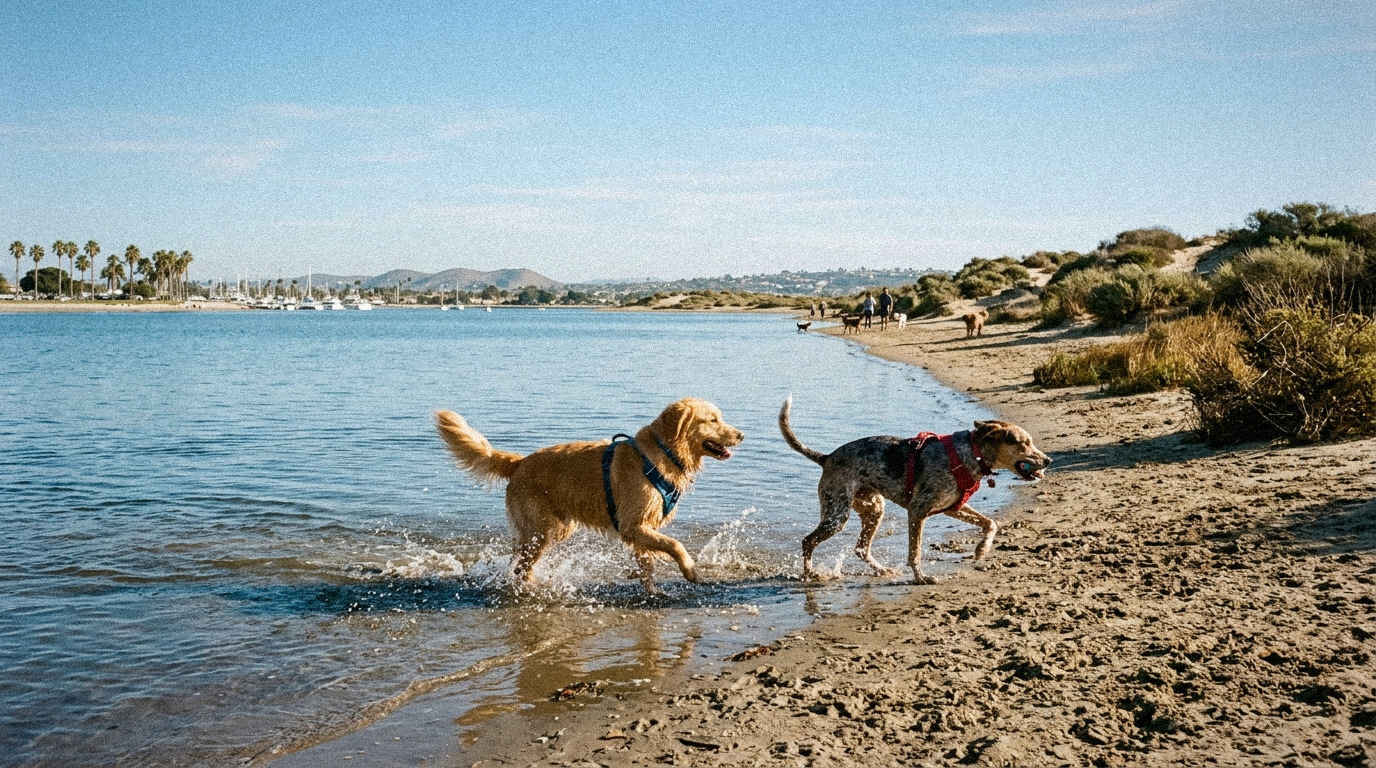
If you drive onto Fiesta Island on a Saturday morning, the scene looks like organized canine bedlam. Hundreds of dogs of every imaginable pedigree gallop across open sand dunes, dive headfirst into the calm waters of Mission Bay, and chase tennis balls through coastal sage scrub without a leash in sight.
Spanning roughly 90 fenced acres in its southwestern pasture—with additional unfenced miles of shoreline stretching around the rest of the perimeter—Fiesta Island is one of the largest municipal off-leash dog exercise areas in the United States. Yet very few of the people tossing balls into the water realize that this sprawling recreation hub exists almost entirely by accident.
Half a century ago, this island was not a breezy seaside retreat. It was an artificial landfill formed from dredging spoils, and for nearly four decades, it functioned as the primary municipal drying basin for millions of gallons of processed human sewage.
From "False Bay" Mudflat to Man-Made Island
Before 1945, Mission Bay did not exist in its present form. Spanish explorers originally christened the estuary Bahía Falsa (False Bay) because ship captains cruising north from San Diego Bay would mistake the shallow tidal inlet for a navigable harbor, only to ground their vessels in shallow mud. For centuries, False Bay was a shifting 4,000-acre labyrinth of shallow salt marshes, eelgrass beds, and braided mud channels fed by the seasonal runoff of the San Diego River.
Following World War II, the City of San Diego and the U.S. Army Corps of Engineers launched an ambitious civil engineering campaign to remake the estuary into a 4,200-acre municipal aquatic playground. Over the course of the late 1940s and 1950s, heavy hydraulic cutterhead dredges scooped more than 25 million cubic yards of sand, silt, and marine sediment from the marsh bottom.
Engineers used that dredged spoil to carve out deep-water recreational channels and deposit massive artificial landmasses across the bay. One of the largest deposits formed a broad, flat, teardrop-shaped island initially labeled "Cabrillo Island" on early engineering blueprints, later renamed Fiesta Island.
The "Fester Island" Era: Sewage Sludge in the Sun (1962–1998)
While other parts of Mission Bay—such as Crown Point, Vacation Isle, and Quivira Basin—received paved parking lots, manicured lawns, palm trees, and resort hotels, Fiesta Island was assigned a far less glamorous municipal role.
In 1962, the City of San Diego placed the Point Loma Wastewater Treatment Plant into operation on the ocean side of the peninsula. While the treated liquid effluent was piped out into the Pacific, the remaining digested solids (sewage sludge) needed somewhere to dry. Planners ran a four-mile underground pipeline from Point Loma straight across the urban core into the center of Fiesta Island.
For the next 36 years, vast open-air evaporation beds covering dozens of interior acres held black, semi-liquid sludge baking beneath the Southern California sun. When prevailing summer breezes shifted toward the east, pungent sulfurous odors drifted across Interstate 5 and into neighboring communities, earning the location its enduring local nickname: "Fester Island." Dried sludge cakes were harvested with heavy tractors and either trucked away or processed into soil amendment.
Because the island's interior was an active industrial utility site, the city never invested in turf grass, irrigation lines, or traditional park structures. In 1972, the city designated the undeveloped sandy margins of the island as a temporary off-leash dog exercise area. Dog owners quickly discovered that the island's natural water boundary, lack of cross-traffic, and rugged sand trails offered an open-space playground impossible to replicate in conventional suburban parks.
The sludge beds finally ceased operation in late 1997 when the city opened the modern Metropolitan Biosolids Center near Miramar, freeing the interior land for long-term environmental remediation and park planning.
The 20-Year Battle for FIDO and Permanent Protection
Once the wastewater sludge was gone, developers and city planners drafted competing visions for Fiesta Island. Over the next two decades, proposed master plan revisions included luxury RV resorts, commercial campgrounds, competitive rowing channels, golf courses, and multi-lane roads that would have chopped the open acreage into small, restricted parcels.
In 2006, local dog advocates formed Fiesta Island Dog Owners (FIDO) to preserve the island's open, continuous off-leash access. FIDO organized volunteer trash cleanups, funded native vegetation replanting, and mounted an organized political campaign.
The debate pitted off-leash recreation against commercial redevelopment and wildlife conservation concerns—most notably protecting nesting habitat for the endangered California least tern (Sternula antillarum browni), which lays its eggs directly on open shell-sand at Stony Point.
The resolution arrived in two historic votes:
- June 2019: The San Diego City Council voted unanimously to adopt "Option B" of the Fiesta Island Amendment to the Mission Bay Park Master Plan, designating roughly 90 contiguous acres in the southwest corner as a permanently preserved, fenced off-leash dog park.
- June 2021: The California Coastal Commission granted final approval in a 6–5 vote, cementing the park's legal boundary while mandating strict seasonal fence buffers around the adjacent least tern nesting preserves.
Fiesta Island has no running tap water anywhere on the island. Keep two one-gallon jugs of fresh tap water and a deep wash bucket in your car trunk. Use one jug for drinking water throughout your walk, and use the second jug to rinse salt, silt, and sand off your dog's paws and coat before they jump back into the car. If you visit on a weekday morning before 9:00 AM, you will often have wide stretches of the eastern beach coves almost entirely to yourself.
Practical Field Advice: Keeping Your Dog Safe on the Island
Because Fiesta Island is a rugged coastal environment rather than a manicured, astroturfed neighborhood park, visiting requires basic situational awareness. Taking a few proactive precautions ensures a safe outing:
1. Watch for Foxtails and Sand Burs (*Cenchrus spinifex*)
The interior sand dunes and native scrub contain patches of wild barley, brome grasses, and coastal sand burs. During the dry season (late spring through autumn), dried seed heads produce razor-sharp barbed awns (foxtails) that easily attach to a dog's coat.
Foxtails do not wash out; their microscopic barbs cause them to work inward through the skin, migrating into paw pads, ear canals, eyes, and nasal cavities. After every visit, perform a methodical physical inspection: check between each toe, inspect the webbing under the paws, look inside the ears, and run your fingers along the chest and groin. If your dog begins sneezing violently or shaking their head repeatedly after a run, consult your veterinarian promptly.
2. Prevent Saltwater Ingestion and Pack Adequate Fresh Water
Because Mission Bay is tidal saltwater, swimming and retrieving floating toys causes dogs to swallow small amounts of brine. When dogs get thirsty from running in soft sand, they may attempt to drink directly from the bay.
Ingesting excessive saltwater draws water from the bloodstream into the gastrointestinal tract, leading rapidly to osmotic diarrhea, vomiting, dehydration, and in severe cases, life-threatening salt toxicosis (hypernatremia). Carry portable water bowls and offer fresh water every 20 minutes to discourage dogs from lapping at the bay.
3. Beware of Buried Fire Coals
Fiesta Island is one of the few places in San Diego where evening beach bonfires are permitted in city-provided concrete fire rings. Unfortunately, irresponsible visitors occasionally build illicit ground fires on open sand or attempt to extinguish ring fires by smothering them with sand instead of water.
Sand acts as an effective thermal insulator. Buried coals can remain hot enough to cause third-degree paw burns up to 24 hours later. Keep your dog near the wet, hard-packed waterline and steer clear of blackened, soot-stained depressions in the upper dry sand.
4. Mind the One-Way Perimeter Road
A 4.2-mile, single-lane paved loop road circles the island in a counter-clockwise direction. The speed limit is 25 mph, but the road is heavily used by road cyclists, time-trial riders, boaters towing watercraft trailers, and recreational vehicles.
If you walk your dog outside the fenced southwestern pasture along the perimeter beaches, maintain continuous visual contact and ensure your dog has dependable voice recall. Excited dogs pursuing sea gulls or other animals can easily bolt across the roadway into oncoming traffic.
5. Shuffle for Stingrays in Calm Shallows
Round stingrays (*Urobatis halleri*) inhabit the warm, shallow sandy flats of Mission Bay from May through October. While dog paws have thick leather pads that rarely suffer stingray injuries, human owners wading into the water to fetch toys or supervise their pets are susceptible to painful barb strikes.
Always do the "stingray shuffle"—sliding your feet along the sandy bottom rather than taking picking-up steps. The vibrations startle rays and encourage them to swim away before you step on them.
6. Respect the Least Tern Nesting Fences
The fenced enclosures at Stony Point (at the southwest corner) and the northern habitat reserve are legally protected breeding sanctuaries for the endangered California least tern from April through August. Terns lay their camouflaged eggs directly on shell-grit sand, and ground disturbance causes adult birds to abandon their nests. Keep dogs strictly away from the sanctuary fence lines to avoid disturbing nesting birds.
Visitor Logistics & Regulations
- Location: 1750 Fiesta Island Road, San Diego, CA 92109 (accessed via East Mission Bay Drive, just west of I-5).
- Operating Hours: 4:00 AM to 10:00 PM daily. The main entrance gate is locked promptly at 10:00 PM; vehicles remaining after hours are subject to municipal citations and impound fees.
- Admission & Parking: Admission is free. Vehicles may park directly on the hard-packed dirt and sand shoulders alongside the perimeter road. Avoid driving into loose, deep beach sand without four-wheel drive, as tow recovery costs on the island are notoriously high.
- Restrooms: Multiple portable chemical toilets are stationed along the perimeter loop. There are no plumbed restrooms, running sinks, or outdoor showers.
- Park Rules: Glass containers, alcohol, and fireworks are strictly prohibited across the entire island. Dog waste must be picked up immediately; dog waste bags and disposal dumpsters are maintained by the city and FIDO volunteers near the main fenced entry points.
Comments