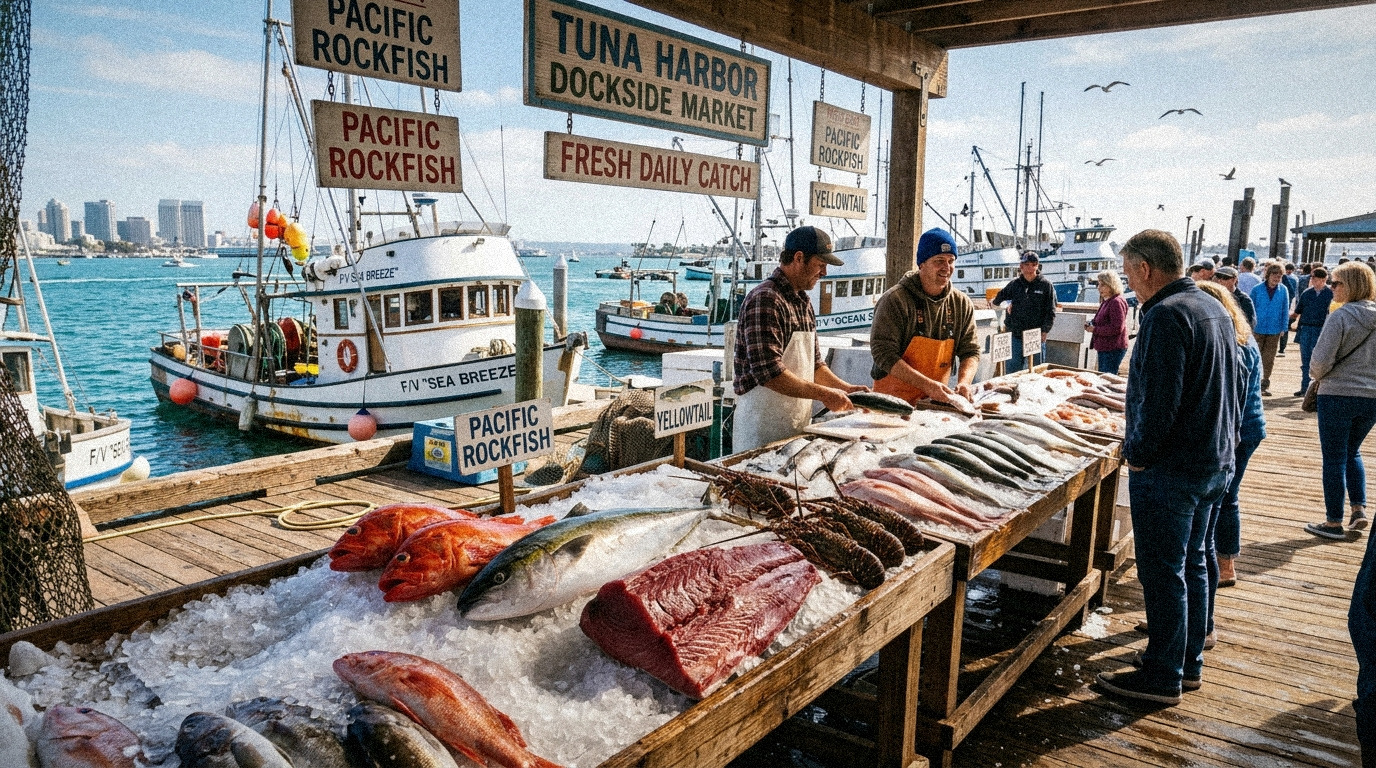
San Diego was once known as the tuna capital of the world, home to hundreds of commercial fishing vessels and massive canning operations lining the downtown embarcadero. While industrial-scale cannery production migrated overseas decades ago, a resilient fleet of generational commercial fishermen still navigates the cold, deep waters of the Southern California Bight. For local residents looking for the freshest seafood imaginable without paying astronomical fishmonger markups, there is only one destination that truly matters: the Tuna Harbor Dockside Market.
Held every Saturday morning on a working wooden pier next to Seaport Village, this open-air, fisherman-run market connects consumers directly with the people who drop the nets, set the traps, and pull the longlines. There are no corporate distributors, no frozen cargo containers from across the globe, and no mystery thawing processes. Every fish on the iced tables was swimming in the Pacific Ocean just hours or days prior.
The Economics of the Dock: How Boat-Direct Sourcing Saves Money
When you purchase seafood at a conventional supermarket, you are paying for an extensive supply chain: distributor brokers, air freight refrigeration, middleman wholesalers, and retail loss margins. At Tuna Harbor Dockside Market, you buy straight from the fishing vessel's captain or crew. That direct transaction fundamentally alters the pricing structure, making premium, wild-caught marine protein remarkably affordable if you are willing to buy whole fish.
1. Whole Rockfish and Groundfish
Pacific rockfish (often labeled "Pacific red snapper" in retail stores) is a sweet, flaky whitefish ideal for whole grilling, steaming, or scratch fish tacos. In supermarkets, rockfish fillets regularly fetch $16 to $20 per pound. At Tuna Harbor, fishermen sell whole, glistening rockfish straight from their coolers for $7.00 to $8.50 per pound. A three-pound rockfish costs under twenty-five dollars and yields generous fillets along with collagen-rich bones and heads perfect for traditional fish stock.
2. Pelagic Gamefish: Yellowtail, Albacore, and Bluefin
Depending on seasonal runs, local boats pull up everything from Pacific yellowtail and albacore tuna to swordfish and offshore bluefin tuna. Whole albacore or local yellowtail frequently sells for $4.00 to $9.00 a pound in the round, or $10.00 to $16.00 a pound as pristine, sashimi-grade loins. Compare that to specialty gourmet markets where fresh bluefin or yellowtail steaks routinely command $32 to $40 per pound.
3. California Spiny Lobster and Sea Urchin (Uni)
During the winter commercial lobster season (October through March), local trap fishermen unload live California spiny lobsters right at the dock. Because these Pacific lobsters lack heavy claws and yield dense, sweet tail and body meat, buying them live at $18 to $22 a pound provides a gourmet feast at roughly half of white-tablecloth restaurant rates. Nearby, commercial sea urchin divers crack live red sea urchins to order for $10 to $12 each, offering immediate spoonfuls of creamy, sweet uni with zero transit degradation.
The Cutting Station: The Market's Best Kept Secret
Many home cooks hesitate to buy whole fish because scaling, gutting, and filleting at home can feel messy and intimidating. The fishermen at Tuna Harbor solved this problem with a dedicated, professional dockside cutting and cleaning station.
Once you select your fish from a boat stall, take your receipt and the fish over to the filleting tent. For a nominal fee of $1.00 to $1.50 per pound, veteran fish filleters will scale, gut, skin, and fillet your catch with razor-sharp precision in less than two minutes. They package the boneless fillets into clean bags and will happily pack the carcass, collar, and head into a separate bag if you want to make rich seafood stock or broil succulent fish collars (kama) at home.
Arrive by 7:45 AM, fifteen minutes before the official 8:00 AM opening bell. A line forms quickly down the wooden pier, and the most coveted items—such as whole yellowtail, California halibut, and live spot prawns—routinely sell out within the first 90 minutes. Bring a heavy-duty hard cooler with blue ice packs in your trunk to keep your fillets ice-cold while you walk the harbor.
What to Cook: Dockside Catch Preparation
Because the seafood here is exceptionally fresh, minimal cooking intervention is required. Here are three simple ways to maximize your purchase:
- Dockside Crudo: Thinly slice fresh yellowtail or albacore loin across the grain. Drizzle with extra virgin olive oil, a splash of fresh lime or yuzu juice, thin serrano pepper rings, and flaky sea salt.
- Whole Roasted Rockfish: Score the skin of a cleaned, scaled rockfish. Rub inside and out with olive oil, crushed garlic, sliced lemons, and fresh herbs (mint, oregano, or cilantro). Roast at 425°F for 20 to 25 minutes until the flesh flakes cleanly off the spine.
- Pan-Seared Fish Tacos: Season rockfish or halibut fillets with ground cumin, Mexican oregano, and sea salt. Sear in a screaming-hot cast iron pan with a spoonful of avocado oil for two minutes per side. Flake into warm corn tortillas with shredded cabbage and lime crema.
Market Location, Hours, and Transit Logistics
Tuna Harbor Dockside Market operates on the pier between the USS Midway Museum and Seaport Village, immediately adjacent to the iconic Fish Market restaurant.
- Address: 598 Harbor Ln, San Diego, CA 92101
- Hours: Open every Saturday from 8:00 AM until 2:00 PM (or until all fish is sold out)
- Payment: Cash and major credit/debit cards accepted by all boat stalls and the cleaning booth
- Parking: Metered parking is available in the public lot along Harbor Lane, but fills early. Alternative parking is available at the Seaport Village surface lots or the USS Midway parking lot.
- Public Transit: Take the MTS Green Line Trolley to the Seaport Village Station; the pier is a scenic 5-minute walk west toward the bay.
Authoritative Outbound References
- Tuna Harbor Dockside Market Official Site — Saturday catch forecasts, participating commercial vessels, and dockside event calendars.
- California Sea Grant (UC San Diego) — Sustainable California seafood profiles, fisheries science, and seasonal harvesting guides.
- California Department of Fish and Wildlife Marine Region — Commercial fishing regulations, marine protected area guidelines, and species status reports.
Comments