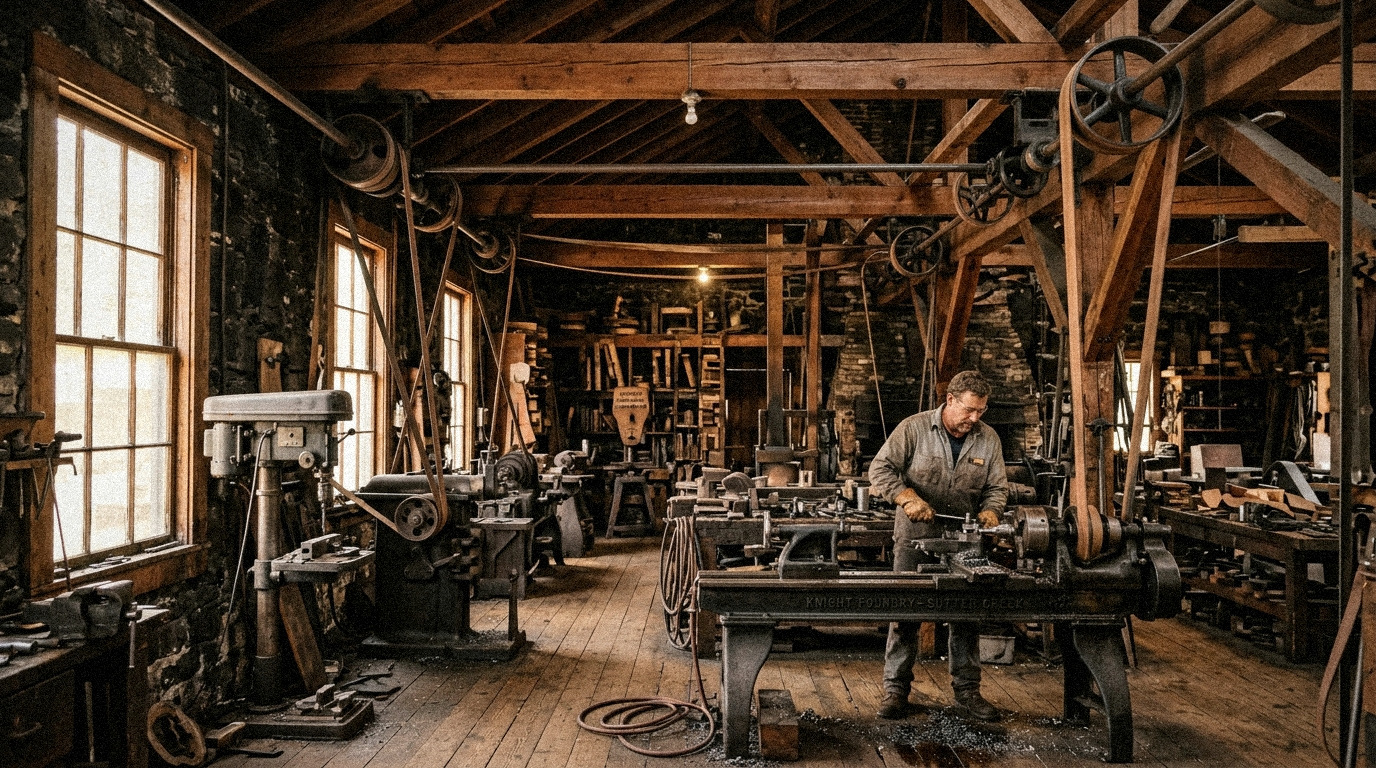
Step off Highway 49 into Sutter Creek, and it is easy to succumb to the tranquil illusion of Sierra foothills wine country: 19th-century brick façades, shady wooden second-story balconies, art galleries, and tasting rooms pouring old-vine Zinfandel. But walk one block up Eureka Street, and the gentle whisper of tourist chatter vanishes, replaced by the deep, resonant metallic scent of coal dust, machine oil, and cold gray iron.
Here stands the Knight Foundry—the last water-powered foundry and machine shop operating in the United States. While modern industry moved to steam, electricity, and computer numerical control (CNC), this unyielding timber-and-brick complex quietly hammered, turned, and cast iron for 123 continuous commercial years from 1873 until 1996. It is not a sanitized modern recreation with plastic placards; it is a living, breathing mechanical organism frozen in the late 19th century, where pressurized water falling from the ridge above still turns the pulleys that drive the lathes.
The Mother Lode's High-Pressure Engineering Genius: Samuel Knight
When the easy placer gold in California’s riverbeds was picked clean by 1853, the Gold Rush did not end—it went subterranean. Mining syndicates had to drill thousands of feet into solid greenstone and slate to follow rich veins of gold-bearing quartz. Hardrock mining was brutal, equipment-intensive work. Stamp mills crushed rock around the clock, heavy iron skips hoisted ore up vertical shafts, and massive Cornish pumps fought back torrential underground aquifers.
All of this heavy machinery wore out constantly under abrasive mountain gravel. Importing replacement iron parts by steamship around Cape Horn took months and cost exorbitant fortunes. The Mother Lode desperately needed its own heavy industrial foundry.
Enter Samuel N. Knight (1838–1913). Born in Maine, Knight trained as a ship’s carpenter before migrating west to California during the Civil War era to work as a millwright in the booming mines of Amador County. Knight possessed an uncanny mathematical and mechanical intuition. In 1872, he partnered with local ironworkers Campbell and Hall, formally establishing Knight & Co. in 1873 on Eureka Street.
Knight recognized that the Sierra foothills possessed an almost limitless natural power source: snowmelt water delivered under tremendous head pressure through hundreds of miles of ditch and flume networks built by mining companies. To harness it, Knight developed and patented the Knight Water Wheel—a heavy cast-iron impulse turbine rimmed with curved, spoon-shaped buckets.
High-pressure water from a tapered nozzle blasted into the curved buckets, transferring nearly all of its kinetic energy to the spinning wheel without wasteful splashing. Hundreds of Knight Wheels were cast right here on the foundry floor and shipped across the American West, powering sawmills, gold quartz mills, and some of the very first municipal hydroelectric plants in California, Oregon, and Utah. While rival inventor Lester Pelton later gained wider worldwide fame with his center-splitter bucket patent, Knight’s wheels laid the kinetic foundation for California’s industrial rise.
Plan your visit for the 2nd or 4th Saturday of the month during official public demonstration days. Volunteer docents open the penstock gate valve, and you can watch the 42-inch Knight Wheel hum to life in real time. The massive leather belts overhead start slapping against the wood pulleys, and master blacksmiths fire up the historic forge. Walk into the pattern shop upstairs: the walls are lined with over 5,000 hand-carved sugar pine wooden patterns dating back to the 1870s, each used to cast a specific gear, valve, or mining cog.
The Anatomy of Water Power: Line Shafts, Belts, and the Cupola Furnace
Inside the machine shop, there is not a single electric motor powering the primary tooling. Instead, water drops hundreds of vertical feet from an elevated ridge reservoir down a steel penstock pipe, generating roughly 120 pounds per square inch of water pressure at the foundry floor.
When the main valve is opened, the jet strikes a 42-inch Knight Wheel mounted beneath the flooring. The spinning turbine drives a vertical jackshaft connected via heavy bevel gears to a master overhead line shaft spanning the length of the building. From this spinning steel spine, a maze of wide leather driving belts descends to vintage machines across the workshop:
- The 1880s Lathes: Long-bed metal lathes capable of turning 20-foot-long steel pump shafts and colossal mining winch drums with precision tolerances.
- The Radial Drill Press: A massive cast-iron arm that swung over massive iron castings to bore bolt holes through several inches of solid metal.
- The Mechanical Shaper and Planer: Reciprocating cutting heads that sheared flat reference surfaces onto rough cast-iron machine bases.
- The Cupola Melting Furnace: In the casting barn, pig iron and scrap metal were layered with coke inside a tall cylindrical cupola furnace. A water-powered blower supplied forced air blast to reach melting temperatures above 2,700°F (1,480°C), allowing molten iron to be tapped into refractory ladles and poured into green-sand molds.
Sutter Creek and the Fortune That Founded Stanford University
The foundry’s survival is deeply woven into the historic fabric of Sutter Creek itself. In 1848, John Sutter (on whose Coloma property gold was first struck) brought a crew of Native American workers to establish a mining camp along this creek, giving the town its name.
Just a few blocks north of the foundry sat the Lincoln Mine. In 1852, a struggling young grocer and lawyer from Sacramento named Leland Stanford bought into the Lincoln Mine for roughly $5,000. Despairing of finding anything after months of hard digging, Stanford nearly sold his stake for $500, but local storekeeper Robert Downs convinced him to hold on and lent him credit.
Shortly thereafter, miners blasted into a massive bonanza quartz vein. The Lincoln Mine yielded more than $2.2 million in pure gold—a staggering sum in the 1850s. That Amador County gold fortune provided Stanford with the essential seed capital to co-found the Central Pacific Railroad, become Governor of California, and eventually endow Stanford University. Without the deep-shaft hardrock engineering perfected in Sutter Creek, modern California history would look fundamentally different.
Rescuing an Industrial Wonder from Extinction
When commercial operations finally ceased in 1996 following the death of its last private operator, the Knight Foundry faced imminent destruction. Scrappers eyed the antique iron, and developers considered razing the site for residential lots. The National Trust for Historic Preservation placed Knight Foundry on its list of America's Eleven Most Endangered Historic Places.
Recognizing that an irreplaceable piece of American engineering was about to disappear forever, local citizens mobilized the Knight Foundry Alliance. In 2017, the City of Sutter Creek officially purchased the historic property with grant assistance, securing its status as a permanent civic cultural treasure. Designated as both a National Historic Mechanical Engineering Landmark by the American Society of Mechanical Engineers (ASME) and listed on the National Register of Historic Places, the foundry has been lovingly restored to fully operational condition by volunteer machinists, millwrights, and historians.
Visitor Logistics and Planning Your Visit
Visitor Essentials & Tour Logistics
- Address: 81 Eureka Street, Sutter Creek, CA 95685 (One block off Highway 49).
- Tour Schedule: Open for self-guided and docent-led walking tours on the 2nd and 4th Saturdays of every month, 10:00 AM – 3:00 PM. Special group tours can be arranged in advance via their website.
- Admission: $15 for adults (18+), $5 for students and youth (ages 5–17), children under 5 are free. All proceeds directly fund equipment maintenance and ongoing historical preservation.
- What to Wear: Closed-toe, sturdy walking shoes are mandatory (this is an authentic 19th-century machine shop with historic floorboards and line shafts). Dress in layers, as the unheated timber buildings match outdoor Sierra temperatures.
- Parking & Strolling: Free parking is available in the foundry lot and along Eureka Street. After your tour, walk down Eureka to Main Street to explore Sutter Creek’s Gold Rush architecture, historic saloons, and local bakery treats.
Comments