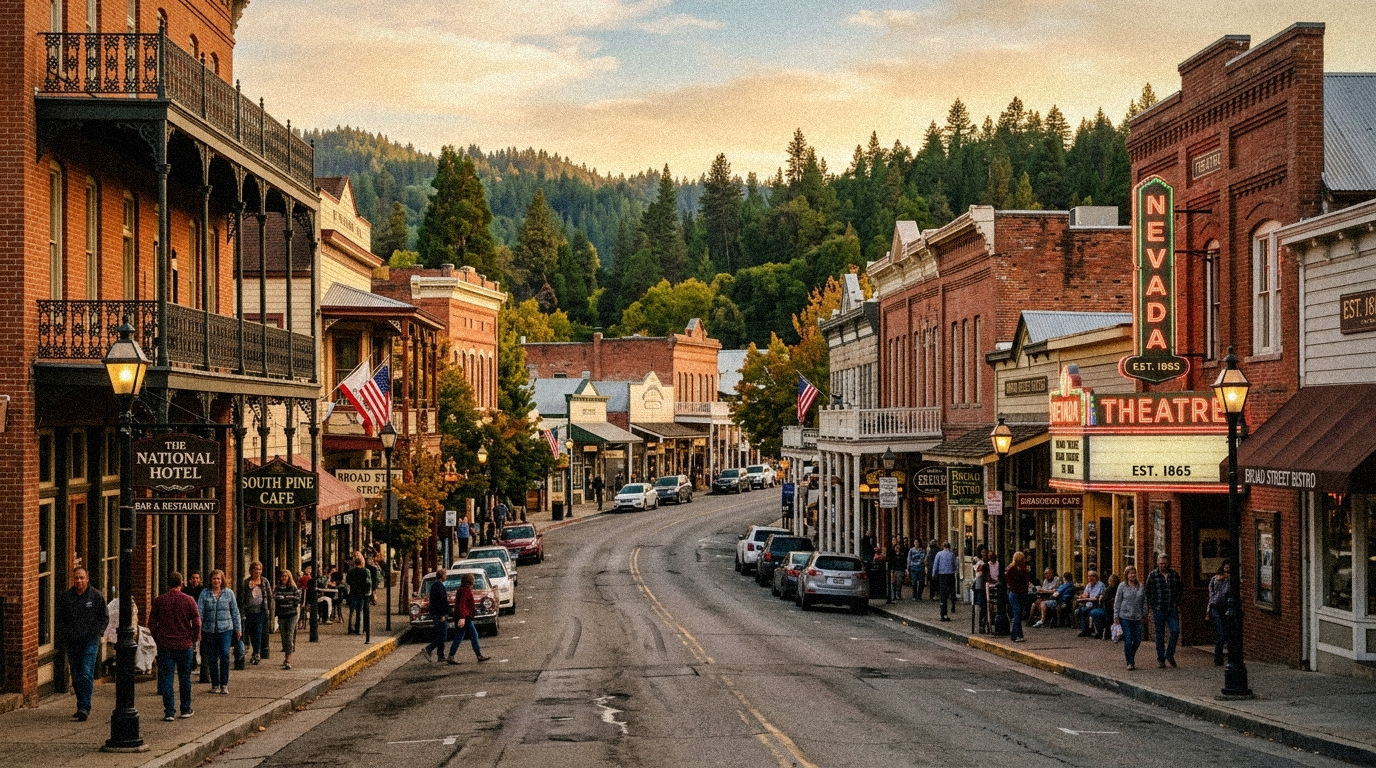
In September 1849, prospectors working their way up the dense pine canyons of the Sierra foothills stumbled upon glittering flakes of placer gold where Gold Run Creek empties into Deer Creek. Within weeks, Dr. A.B. Caldwell threw up a rough log trading post known colloquially as "Caldwell’s Upper Store." By the following spring, that solitary log cabin had metastasized into a roaring tent-and-shanty metropolis of over ten thousand miners, prospectors, gamblers, and merchants. They christened it Nevada—Spanish for "snow-covered"—years before the neighboring territory poached the name for an entire state, forcing the town to append "City" to its moniker.
Unlike dozens of sister Gold Rush camps that withered into crumbling stone foundations or ghostly hollows of blackberry brambles, Nevada City pulled off an extraordinary trick: it survived, adapted, and preserved its architectural soul. Today, stepping onto the curving gradient of Broad Street feels less like entering a museum and more like stepping onto an 1860s theater set. Gas lamps cast a warm glow across red-brick facades, ornate cast-iron balconies hang over wooden walkways, and the mountain air smells of ponderosa pine and woodsmoke.
Trial by Fire: Forging a Mountain City in Brick and Stone
The storybook Victorian streetscapes visible today were born out of sheer disaster. Early Nevada City was an incendiary tinderbox of pitch-pine lumber, canvas tents, and open hearths crammed into a steep river ravine. Catastrophe arrived with clockwork regularity: massive infernos in 1851, July 1856, and November 1863 repeatedly incinerated the downtown commercial district, reducing millions of dollars in merchandise and gold dust to smoldering ash in minutes.
Exhausted by rebuilding wooden shacks, the town's merchants made a collective pact after the 1856 fire: never again. They rebuilt their empire in fireproof materials quarried directly from the Sierra foothills:
- Subterranean Schist and Brick: Foundations and walls were constructed using local greenstone, serpentine schist, and millions of clay bricks kilned in regional yards.
- Heavy Iron Fire Shutters: Every upper-story window and ground-level entryway was fitted with double-hinged, thick boiler-plate iron shutters designed to slam shut against radiant heat and embers.
- Sand-Insulated Roofs: Builders layered several inches of dry river sand beneath tin and corrugated iron roofing to prevent burning embers from igniting the attic rafters below.
Because the merchants built for permanence rather than short-term plunder, the entire historic commercial district survived the collapse of placer mining, earning designation as a National Historic Landmark in 1985.
The National Exchange Hotel: Gold Barons and Ghostly Grandeur
Anchoring the lower end of Broad Street is The National Exchange Hotel. Established in August 1856 immediately following the great summer fire, it stands proudly as one of the oldest continuously operating hotels west of the Mississippi River.
In its Gilded Age heyday, the hotel was the political and financial nerve center of the Northern Mines. Governors, railroad magnates, and mining tycoons sealed multi-million-dollar deals over bourbon at the mahogany bar. Telegraph dispatches announcing the outcomes of Civil War battles and the assassination of Abraham Lincoln were read aloud from its second-story balcony to crowds packing the dirt street below.
A multi-year, multi-million-dollar historic restoration recently restored the three-story brick landmark to its late-19th-century Victorian interior. The parlor rooms are clad in reproduction William Morris wallpaper, antique gold-leaf mirrors, deep velvet armchairs, and vintage brass chandeliers. Sitting in the hotel's National Room sipping a botanical cocktail feels like lingering in an 1870s salon, right down to the creak of the Douglas fir floorboards.
The Nevada Theatre and Mark Twain’s Platform
A short stroll up Broad Street brings you to 401 Broad: the Nevada Theatre. Opened on September 9, 1865, it is California’s oldest existing theater building still in active use. Its yellow brick facade and arched timber roof have witnessed every chapter of California’s cultural evolution.
In an era when traveling troupes and speakers were the sole source of news and entertainment, the stage welcomed legends:
- Mark Twain: In October 1866, freshly returned from his formative travels in the Sandwich Islands (Hawaii), a young Samuel Clemens walked onto the stage of the Nevada Theatre to deliver his very first professional public lecture. The house was packed to the rafters, and Twain’s irreverent humor launched his public lecturing career.
- Emma Nevada: The theater was a second home to local soprano Emma Wixom, who adopted the stage name Emma Nevada and became an international opera sensation across London, Paris, and Milan.
- Silent Screen Pioneers: When vaudeville waned, the building converted into an early motion picture cinema, screening silent reels before community activists saved it from the wrecking ball in the 1960s.
Don’t just stick to the shops on Broad Street. Walk behind the historic district down to the Deer Creek Tribute Trail. Cross the Miners Trail suspension footbridge swinging above Deer Creek’s granite boulders, and read the interpretive markers honoring the indigenous Nisenan people and the thousands of Chinese miners who built the rock-walled water flumes that carved modern California.
Lester Pelton and the Miners Foundry: Powering the World
Down on Spring Street sits an imposing fortress of dark stone and timber: the Miners Foundry. Established in 1855 by Edward Coker as the Nevada Iron Foundry, it was rebuilt in local schist and stone after the 1856 fire. For half a century, its roaring blast furnaces, steam hammers, and pattern shops manufactured heavy machinery for deep-shaft quartz gold mines across the Pacific Rim.
In 1879, a quiet local carpenter and tinkerer named Lester A. Pelton brought an idea to the foundry. Traditional water wheels were horribly inefficient at handling the ferocious water pressure blasted down Sierra pipelines. Pelton designed a revolutionary wheel with split bucket cups: when a jet of water struck the center ridge of the cup, it split and reversed direction, transferring nearly 90 percent of the water's kinetic energy into rotational momentum.
Manufactured at the Miners Foundry, the Pelton Wheel revolutionized global energy. It powered the underground stamp mills of the Empire Mine, ran deep-shaft air pumps, and became the core engineering prototype for modern high-head hydroelectric turbines still generating electricity in power stations across the world today.
Actionable Logistics: Planning Your Visit
Nevada City sits in Nevada County along Highway 49, approximately 60 miles northeast of Sacramento and 2,500 feet above sea level:
- Best Seasons to Visit: Autumn (October–November) brings brilliant sugar maples, liquidambars, and oaks blazing in scarlet and gold across Victorian hillsides. December features the annual Victorian Christmas street faire with carolers in period dress, roasted chestnuts, and horse-drawn carriages.
- Where to Stay & Dine: Book a room at The National Exchange Hotel or a historic Victorian B&B. For dining, grab wood-fired pizza at Three Forks Bakery & Brewing Co. or seasonal farm-to-table cuisine at The Golden Gate Saloon.
- Walking the Historic District: Downtown is compact and easily walkable, but wear sturdy shoes: streets like Broad, Commercial, and Pine climb steep canyon grades.
- Parking: Free street parking is available along Commercial and Spring Streets, plus a large municipal pay lot at Commercial and Pine Street ($2–$4/hour).
Comments