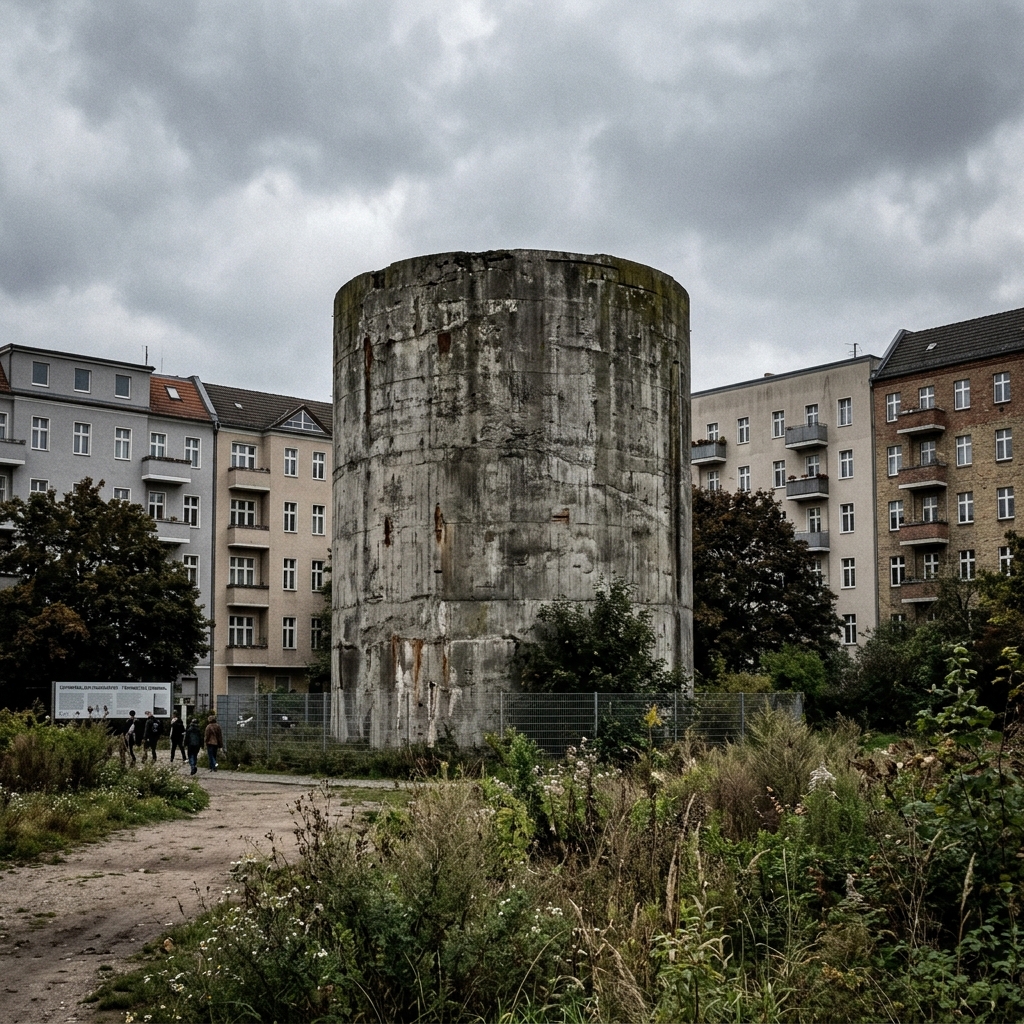
Tucked away between railway tracks and quiet residential allotments on General-Pape-Straße in Berlin-Tempelhof sits one of the strangest and most chilling relics of the Third Reich. It is not an anti-aircraft bunker, an underground air-raid shelter, or a military fortress. It is a gigantic, monolithic cylinder of solid reinforced concrete thrust deep into the earth—the Schwerbelastungskörper (literally "Heavy Load-Bearing Body"). Weighing an astounding 12,650 metric tons, this colossal concrete plug was engineered for a single purpose: to serve as a massive, megalomaniacal soil-pressure experiment for Adolf Hitler and Albert Speer's fantasy metropolis, Welthauptstadt Germania.
While almost all architectural remnants of the regime were blasted to rubble during World War II or demolished in the postwar cleanup, the Schwerbelastungskörper stubbornly refused to die. It remains today because postwar demolition experts quickly realized that blowing apart a 12,000-ton block of solid concrete would shatter neighboring residential apartment blocks and sever Berlin’s southern rail arteries. As a result, it survives as an accidental open-air museum—a physical monument to totalitarian hubris defeated by the laws of basic soil mechanics.
The memorial site is an easy 6-minute walk north from S-Bahn station Südkreuz. Climb the open-air steel viewing platform (free admission) for a striking perspective looking straight down onto the top of the massive concrete cylinder and across the active railway cutting. Information panels in German and English explain the subterranean measurement gauges and forced labor history.
The Delusion of Welthauptstadt Germania
To grasp why this concrete monster was cast, one must examine the staggering scale of Hitler and Speer's master plan. As the General Building Inspector for the Reich Capital (Generalbauinspektor für die Reichshauptstadt, or GBI), Albert Speer was tasked with transforming Berlin into Germania—a monumental imperial capital designed to project intimidation on a global scale.
The centerpiece of the transformation was a monumental seven-kilometer North-South Axis (Nord-Süd-Achse). At its northern terminus stood the Volkshalle (Great Hall), a dome so colossal it was designed to accommodate 180,000 people and generate its own indoor weather through exhaled condensation. At the southern terminus, Speer designed a gargantuan Triumphal Arch (Triumphbogen). Intended to commemorate German dead from World War I and celebrate future conquest, Speer’s arch was planned to stand 117 meters (384 feet) high and 170 meters (558 feet) wide—so enormous that Paris’s Arc de Triomphe could comfortably fit inside its central vault opening.
Yet Speer’s grandiose blueprints collided with an unyielding natural obstacle: Berlin’s geology. Berlin is situated in a glacial spillway (Urstromtal). The city's native ground is composed of loose alluvial sand, silt, gravel, and high groundwater tables. If a structure weighing millions of tons of solid granite and masonry were constructed on loose marshy sand, the sheer downward pressure risked causing the colossal monument to tilt, sink, or catastrophic structural collapse.
Engineering a 12,650-Ton Concrete Plug
To determine whether Berlin’s swampy subsoil could physically bear the immense point-load of one of the Triumphal Arch's massive supporting pillars, Speer’s office commissioned the German Society for Soil Mechanics (Deutsche Gesellschaft für Bodenmechanik, or Degebo) to conduct an empirical load test.
Between 1941 and 1942, the prominent contracting firm Dyckerhoff & Widmann utilized French prisoners of war as forced laborers to construct the test cylinder on General-Pape-Straße. The engineering specifications remain mind-boggling:
- Visible Dimensions: The cylinder stands 14 meters (46 feet) above ground level, with a diameter of 21 meters (69 feet).
- Subterranean Shaft: Beneath the visible surface, a circular foundation shaft extends nearly 18 meters (59 feet) deep into the earth.
- Mass and Pressure: The solid mass of reinforced concrete weighs approximately 12,650 metric tons, exerting a ground pressure of 12.65 kilograms per square centimeter (over 12 bars of downward pressure).
- Internal Measurement Core: A vertical central shaft was bored through the heart of the block, outfitted with precision gauges, electrical sensors, and level indicators to record minute millimeter shifts against the surrounding clay layers.
The Verdict of the Soil: The Megalomania Collapses
Speer’s engineers calculated that the maximum tolerable subsidence for the planned Triumphal Arch over its lifetime was six centimeters (approx. 2.4 inches). Any settlement beyond that threshold would produce severe structural cracking across the masonry vaults, causing the arch to fracture under its own asymmetric load.
Testing began in late 1941. Degebo scientists systematically recorded the dial gauges throughout 1942, 1943, and 1944, even as Allied bombing raids devastated Berlin. When the data was finally compiled, the verdict of the earth was absolute and humiliating: the cylinder had sunk over 19.3 centimeters (7.6 inches) into the marshy ground—more than three times the maximum permissible threshold.
The marshy Berlin subsoil had definitively rejected Hitler’s triumphal arch. Had construction gone forward according to Speer’s timeline, the colossal monument would have cracked apart and slowly foundered into the sand. The grandest imperial project in European history was geologically doomed before the first block of decorative granite was even laid.
Postwar Survival and Monument Protection
In the chaotic aftermath of May 1945, Allied military authorities and Berlin municipal planners set out to systematically eliminate Nazi monuments across the city. The Schwerbelastungskörper, however, proved virtually indestructible. In 1948, French military engineers surveyed the site with plans to detonate the cylinder. Their calculations quickly revealed that the quantity of dynamite required to shatter 12,650 tons of solid reinforced concrete would blow out windows across Tempelhof, damage nearby apartment tenements, and collapse the adjacent S-Bahn and freight railway lines.
Abandoned and forgotten, the colossal cylinder was swallowed by scrub brush and wild acacia trees for decades. Neighborhood children climbed its perimeter, while railway workers barely spared it a glance. In 1995, the Berlin State Monument Authority officially granted the site heritage protection (Denkmalschutz) as an indispensable historical and architectural artifact.
In 2009, the Tempelhof-Schöneberg district museum opened an official information pavilion and a lightweight viewing tower alongside the cylinder. Today, visitors can ascend to eye level with the concrete rim, examine the exposed core shaft, and read archival blueprints detailing the catastrophic delusions of the Third Reich.
Schwerbelastungskörper Visitor Essentials
- Location: General-Pape-Straße 34A, 12101 Berlin (Bezirk Tempelhof-Schöneberg).
- Hours: Grounds and viewing tower open Tuesday, Wednesday, Thursday, Saturday, and Sunday from 10:00 AM to 6:00 PM (closed Mondays and Fridays; closes at 4:00 PM November through March).
- Admission: Free entry.
- Public Transit: Take S-Bahn S2, S25, S26, S41, S42, or S46 to Berlin Südkreuz (approx. 6-minute walk east via General-Pape-Straße).
- Accessibility: Ground-level pavilion is wheelchair accessible; the viewing tower features stairs leading to an elevated observation deck.
Authoritative Historical Resources
To dive deeper into the architectural archives of Welthauptstadt Germania, the engineering legacy of the Schwerbelastungskörper, and Berlin's wartime archaeology, visit these official portals:
- VisitBerlin: Official Guide to the Schwerbelastungskörper – Practical visitor information and municipal background from the city’s official tourism organization.
- Museen Tempelhof-Schöneberg Official Portal – The municipal museum body that operates the Schwerbelastungskörper exhibition pavilion and educational archives.
- Berliner Unterwelten e.V. Historical Association – Non-profit organization conducting expert research, publications, and subterranean architectural tours throughout Berlin.
Comments