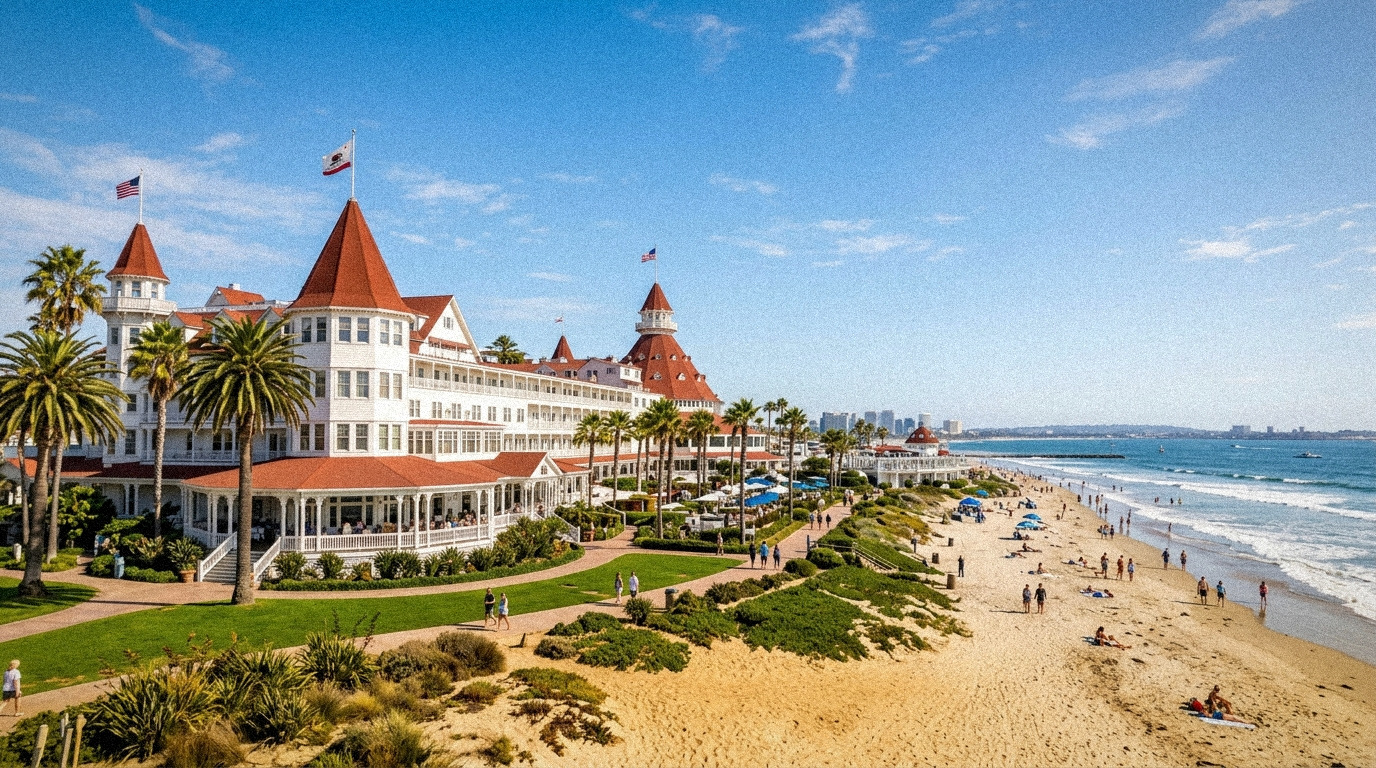
In late 1885, retired Midwestern railway executive Elisha Babcock Jr. and piano manufacturer Hampton L. Story rowed across San Diego Bay to hunt wild jackrabbits on an uninhabited peninsula of coastal scrub and shifting dunes. As the story goes, Babcock paused mid-hunt, took in the sweeping arc of the Pacific surf, and turned to Story with an audacious wager: they would build a seaside resort so grand that it would become "the talk of the Western world." Three years and over a million dollars later, the Hotel del Coronado threw open its doors in February 1888 as the largest wooden structure in the United States and a premier example of late-19th-century American resort architecture.
More than a century later, "The Del" remains an extraordinary living monument. Standing on the golden sand of Coronado Beach beneath its signature conical red turrets and whitewashed gingerbread trim, you are looking at one of the sole surviving relics of the Gilded Age's grand wooden beachfront resorts. It has weathered economic panics, military takeovers, architectural trends that leveled similar landmarks, and the relentless corrosion of Pacific salt spray.
The Reid Brothers and the Eureka Timber Flotilla
To bring their seaside palace to life, Babcock hired Indiana architects James and Merritt Reid (Reid & Reid), who had never built anything close to this scale. The logistical obstacles were staggering. Southern California in the late 1880s had no deep-water freight piers, no local heavy lumber mills, and an acute shortage of skilled construction labor.
The Reid brothers solved the materials crisis by commissioning an entire flotilla of schooners from the Dolbeer & Carson Lumber Company in Eureka. Massive rafts of ancient Northern California old-growth redwood and Douglas fir were towed down hundreds of miles of open Pacific coastline directly onto the Coronado shore. Meanwhile, Babcock recruited hundreds of Chinese laborers from San Francisco, who operated dedicated planing mills, kilns, and iron foundries directly on the building site.
Working day and night in double shifts, the crews finished the sprawling 399-room Queen Anne Victorian complex in just eleven months. The design embraced the classic Victorian romance of asymmetrical rooflines, polygonal corner towers, wrap-around verandas, and elaborate fish-scale shingling—all wrapping around a lush, sheltered central garden patio that shielded winter guests from brisk offshore breezes.
The Crown Room: 9,600 Square Feet Without a Single Nail
The Reid brothers' structural carpentry is most visible inside the Crown Room. Conceived as the main dining hall, this colossal space measures 160 feet long by 60 feet wide and rises 33 feet into a sweeping, ribbed elliptical arch.
The ceiling's engineering is notable for how it spans the room:
- Pillar-Free Sightlines: Built entirely without interior columns or vertical support beams, the room offers unobstructed sightlines across nearly 10,000 square feet of floor space.
- Sugar-Pine Joinery: The entire vaulted ceiling is panelled in clear Oregon sugar pine, fitted together by master joiners using an intricate system of tongue-and-groove carpentry, interlocking wooden pegs, and dowels—constructed without driving a single nail into the overhead expanse.
- Baum’s Crown Chandeliers: Suspended from the pine vault are the famous crown-shaped brass chandeliers. According to Coronado lore, these fixtures were sketched by author L. Frank Baum, who lived on Coronado during the early 1900s while writing The Emerald City of Oz and Dorothy and the Wizard in Oz.
The Electric Frontier: Myth, Mather Dynamos, and Gas Jets
When The Del opened in 1888, electric lighting was viewed by the public with deep skepticism and outright terror. Most domestic travelers believed electric wires leaked invisible toxins or sparked instantaneous fires. To hedge their bets, the builders installed dual gas-and-electric fixtures throughout the entire hotel.
Local myth often claims that Thomas Edison personally wired the resort. In truth, the installation was engineered by the Mather Electric Company of Connecticut, who installed five massive steam-driven dynamos in a brick powerhouse on Orange Avenue. The facility generated so much power that it not only lit the hotel's 2,500 incandescent bulbs but also supplied the entire fledgling municipality of Coronado with its very first streetlights. Guests were greeted with printed cards beside bedside switches gently reassuring them: "This room is equipped with Edison Electric Light. Do not attempt to light with match. Simply turn key on wall by the door. The use of electricity for lighting is in no way harmful to health, nor does it affect the soundness of sleep."
You do not need an expensive room key to experience the historic public spaces of The Del. Walk through the original Victorian front entrance, visit the lower-level History Gallery (featuring archival photographs, architectural artifacts, and Marilyn Monroe memorabilia), and then grab an espresso or local craft beer at the Sun Deck patio to watch the sunset directly over Point Loma and the Pacific breakers.
Hollywood Royalty, British Scandals, and the "Beautiful Stranger"
The Del has served as the backdrop for cultural watershed moments for over thirteen decades. In 1958, director Billy Wilder chose the resort to stand in for a 1920s Florida hotel in his comedy classic Some Like It Hot. Guests gathered along the seawall to watch Marilyn Monroe, Jack Lemmon, and Tony Curtis shoot scenes on the beach, cementing the resort’s status in cinema history.
Decades earlier, in April 1920, the hotel hosted an official state banquet for Edward, Prince of Wales. Living in Coronado at the time was a young naval wife named Wallis Warfield Spencer. While royal biographers still debate whether they formally met during the reception in the Crown Room, the Coronado social circle formed the catalyst for the romance that would ultimately cause Edward VIII to abdicate the British throne in 1936.
And then there is Kate Morgan, the "Beautiful Stranger." On Thanksgiving Day 1892, the 24-year-old checked into room 302 (now 3327) under an alias, visibly ill and awaiting a companion who never arrived. Five days later, she was found dead from a gunshot wound on the exterior granite staircase leading to the beach. Her ghost remains California's most famous resident spirit, inspiring countless investigations, books, and curious late-night elevator sightings.
Actionable Logistics: Planning Your Visit
Whether you are touring the historic lobby or spending a sunny afternoon on the sands of Coronado, here is what you need to know:
- Historic Preservation Tours: The Coronado Historical Association leads 90-minute docent-led walking tours through the Victorian building and grounds. Tickets run $25–$30 and can be booked online through coronadohistory.org.
- Beach & Grounds Access: Coronado Beach is completely open to the public 24/7. The paved boardwalk running between the hotel and the sand is ideal for strolling or cycling.
- Getting There: Take the Coronado Ferry from San Diego's Broadway Pier to the Coronado Ferry Landing (a 15-minute crossing), then hop on the free MTS Route 904 shuttle directly down Orange Avenue to the hotel. Driving across the 2.1-mile Coronado Bay Bridge offers dramatic bay vistas, though bridge traffic backs up on weekend mornings.
- Parking Advice: On-site resort valet and self-parking can be steep ($40+). Free street parking is readily available along the residential streets off Adella Avenue and Alameda Boulevard, just a 5-minute walk from the resort entrance.
Comments