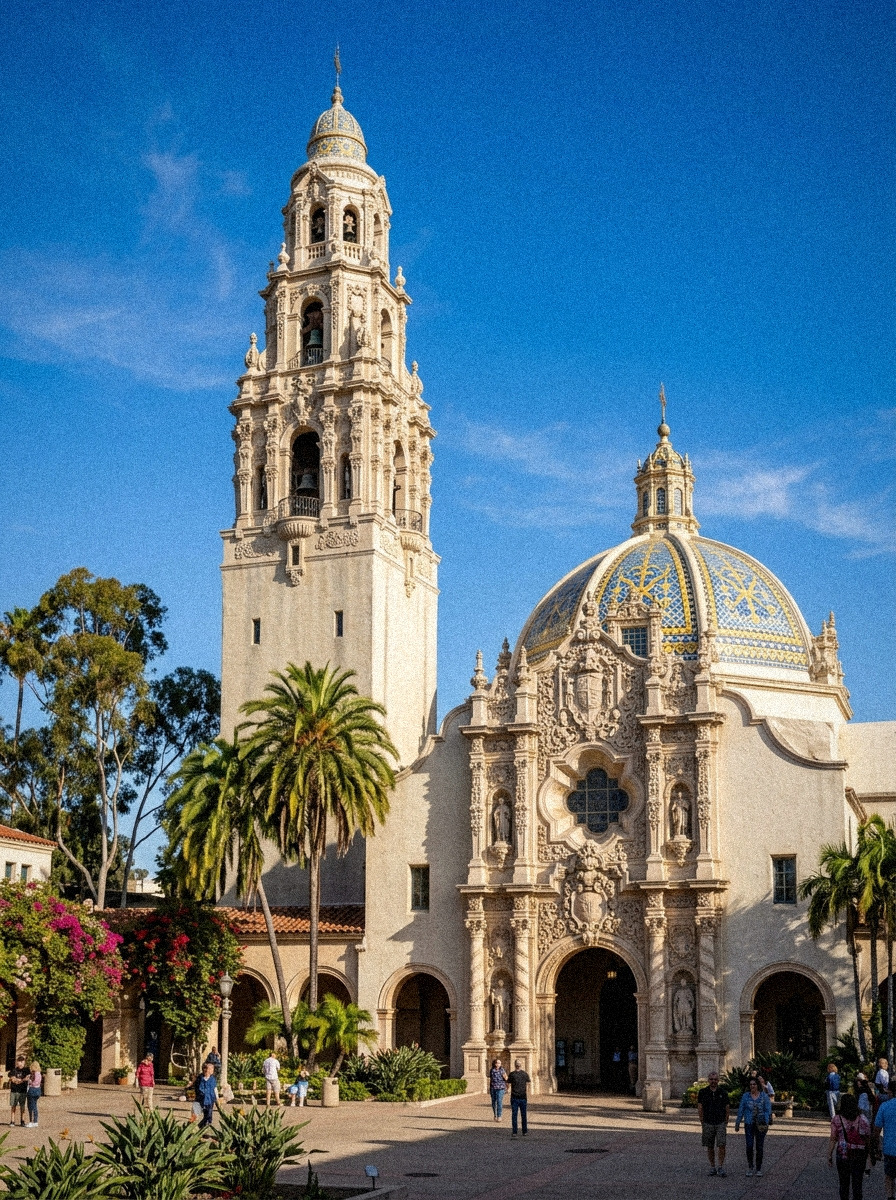
When cities build world's fairs, they almost always look to ancient Rome or Greece for validation. In 1893, Chicago’s World's Columbian Exposition erected an imposing "White City" of plaster columns, pediments, and Beaux-Arts monuments that set the template for civic American ambition. But in 1911, when the modest border city of San Diego—then home to barely 40,000 residents—announced it would host an international exposition celebrating the opening of the Panama Canal, master architect Bertram Grosvenor Goodhue staged a quiet revolution against the Greco-Roman orthodoxy.
Goodhue argued that plaster neoclassical temples made zero architectural sense on the dry, sun-drenched coastal mesas of Southern California. Instead, he looked south toward the exuberant, hyper-ornate Spanish Baroque and Churrigueresque cathedrals of Mexico and Spain. The crowning achievement of his vision was the California Building and California Tower—a soaring, 200-foot confection of carved stone, Moorish arches, and polychrome glazed tiles that forever transformed Southern California's architectural identity and established what the world now recognizes as the Spanish Colonial Revival style.
The Architecture of Illusion: Churrigueresque Mastery in Balboa Park
Approaching the California Building across the sweeping concrete arches of the Cabrillo Bridge feels less like entering a public municipal park and more like approaching a grand Spanish cathedral in Oaxaca or Guanajuato. Goodhue, working alongside project architect Carlton Monroe Winslow Sr., designed the complex as a monumental western gateway to the 1915 Panama-California Exposition.
The architectural style is specifically Churrigueresque—an intensely expressive, late-Baroque Spanish idiom named after 17th-century sculptor José Benito de Churriguera. It is defined by densely concentrated ornamentation that frames structural openings while leaving adjacent walls relatively stark. The effect is dramatic: smooth plaster walls suddenly erupt into cascades of spiraling acanthus leaves, cherubs, cornucopias, and ornate heraldic shields.
The main façade of the California Building functions as a stone-carved historical timeline. Goodhue commissioned master sculptors Attilio and Furio Piccirilli—the New York stone carvers who would later carve Daniel Chester French’s seated Abraham Lincoln for the Lincoln Memorial in Washington, D.C.—to execute the complex sculptural program. Nine life-sized historical figures flank the portal:
- Father Junípero Serra: Stands at the topmost apex niche holding a cross, representing the founding of the California mission system in San Diego in 1769.
- Portuguese and Spanish Navigators: Juan Rodríguez Cabrillo (who sailed into San Diego Bay in 1542) and Sebastián Vizcaíno (who surveyed the harbor in 1602).
- Spanish Royalty: King Charles V of Spain and King Philip II, whose empires funded global maritime exploration.
- Early Explorers and Chroniclers: Fray Antonio de la Ascensión, the Carmelite friar and diarist of Vizcaíno's expedition, alongside Franciscan missionary Junípero Serra's mentor, Father Francisco Palóu.
Tower climb tours run in small groups of 12 people and require reserving timed tickets several days in advance, especially for weekend morning slots. The climb includes 125 steps up a spiral staircase, but the 8th-floor outdoor balcony gives you an unobstructed 360-degree vista from the Cuyamaca Mountains and downtown skyline out to Point Loma and the Coronado Coronado Islands in Mexico. Time your climb for 11:45 AM to hear the 100-chime carillon play its noon concert right below your feet!
The California Tower: Engineering an Urban Beacon
Soaring 198 feet into the coastal sky, the California Tower transitions through three distinct geometric phases as it rises: a sturdy, square reinforced-concrete base; a tapering octagonal mid-tier framed by urns and balustrades; and an open-air belfry crowned by an octagonal cupola.
The cupola and the adjacent main building dome are clad in thousands of brilliant blue, yellow, seafoam green, and black ceramic tiles arranged in intricate geometric starburst patterns. In 1914, rather than importing expensive Spanish ceramics across war-torn Atlantic shipping lanes, Goodhue partnered with the California China Products Company in nearby National City. The local tilemakers developed custom lead-glazed earthenware that reflected the blinding California sunshine with diamond-like intensity, proving that American artisans could rival centuries-old European craftsmanship.
Unlike most of the temporary wood-and-staff plaster pavilions constructed for the 1915 Exposition—many of which were slated for demolition the moment the fair closed—the California Building was built of steel-reinforced concrete, designed specifically as a permanent cultural institution for the City of San Diego.
From Colonial Showcase to the Museum of Us
After the fair ended in 1916, the building became the San Diego Museum of Man, created to house the massive archaeological, biological, and physical anthropology collections amassed for the 1915 Exposition under the direction of famed Smithsonian anthropologist Dr. Aleš Hrdlička.
Over the ensuing century, the museum underwent a profound cultural evolution. In 2020, the board officially changed its name to the Museum of Us. Rather than viewing non-Western cultures through a detached 19th-century colonial lens, the museum embarked on an institutional decolonization process, partnering directly with the Indigenous Kumeyaay Nation—the sovereign people whose ancestral lands encompass Balboa Park—to tell their own living stories, traditions, and resilience alongside world exhibits on race, Mayan archaeology, and brewing history.
For nearly 80 years, the upper decks of the California Tower remained strictly locked behind steel doors due to municipal liability and seismic concerns following the 1935 California Pacific International Exposition. But in 2015, following a meticulous multi-million-dollar seismic retrofit that anchored the concrete core to bedrocks below, the tower finally reopened to the public for its centennial celebration.
Visitor Logistics and Planning Your Visit
Visitor Essentials & Tower Access
- Address: 1350 El Prado, Balboa Park, San Diego, CA 92101
- Museum Hours: Wednesday through Sunday, 10:00 AM – 5:00 PM (Closed Mondays and Tuesdays).
- Admission: General Museum of Us admission is $19.95 for adults, $16.95 for seniors/military/students, and $14.95 for youth (ages 6–17). Tower Climb combo tickets are $29.95 for adults (includes full museum access).
- Climb Requirements: Climbers must be at least 6 years old and able to navigate 125 steps on stairs and historic spiral iron treads without assistance. Handbags and backpacks must be stored in free lockers before ascending.
- Parking & Transit: Park for free in the Inspiration Point parking lot on Park Boulevard and ride the free Balboa Park Tram into Plaza de Panama, or park in the Alcazar Garden lot immediately south of the building. MTS Bus Route 7 and Route 215 drop off right at Park Blvd & Presidents Way.
Comments